

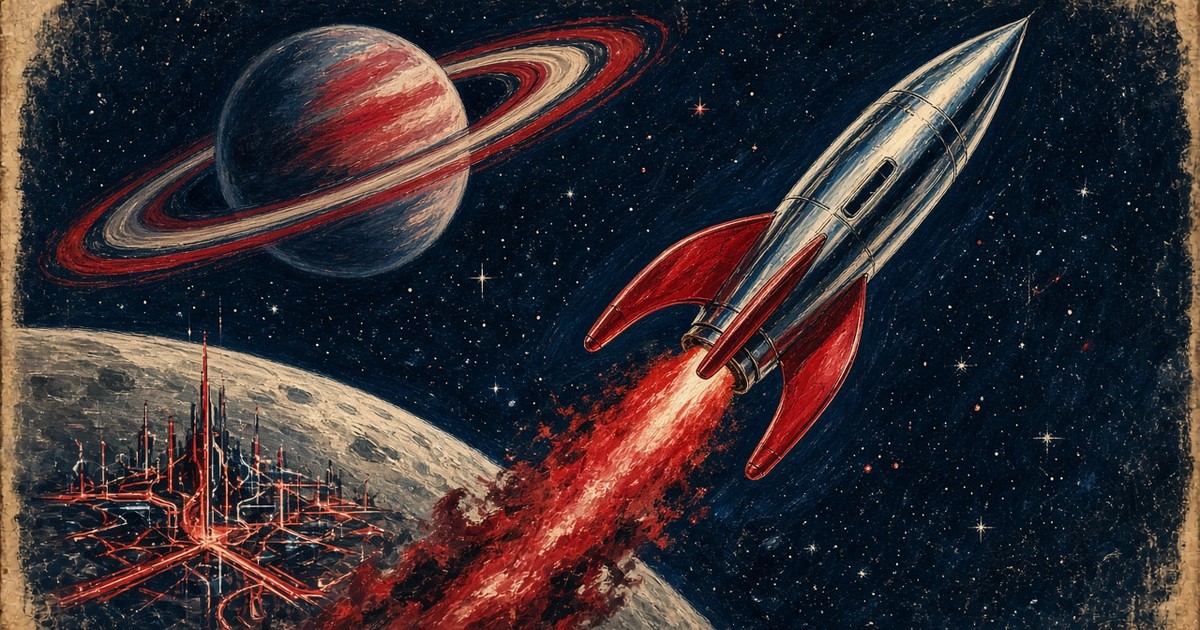
Some futures arrived as dust jackets. This Opinion piece is our argument about twenty science-fiction novels that still shape how engineers, lawyers and politicians talk about tomorrow — and ten favourites we keep pressing into people’s hands — read through the cover art that sold them. Awards and the 1998 Locus all-time poll are the spine. The pictures are the gossip.
Ad: this article contains affiliate links, marked (Ad). If you buy through them, we earn a commission. It does not affect what we say. As an Amazon Associate we earn from qualifying purchases.
How we choose what to recommend: How we review and Independence.
How we picked the twenty
Critical standing here means dated receipts, not vibes. We anchored Part 1 on the 1998 Locus all-time best SF novel poll (opens in a new tab) (results published in Locus, August 1998; votes limited to books published before 1990), then cross-checked Hugo and Nebula Best Novel wins and — for Asimov’s Foundation sequence — the special 1966 Hugo for Best All-Time Series. Where a later book (Snow Crash, The Three-Body Problem) sits outside that poll’s cut-off, we say so and lean on awards plus documented influence instead. This is Opinion: other shelves are possible; this is the one we will defend.
Cover reproductions are for criticism only. We host our own files, credit the artist, and do not lightbox or hotlink. Where a living artist or estate sells prints of that painting, we keep the web copy small.
Part 1 — Twenty that changed the conversation
1. Frankenstein — Mary Shelley (1818)
Before rockets, before robots with three laws, there was a student who stole body parts and called it research. Shelley’s novel is the template for every story in which a builder meets the thing he built and flinches. On the 1998 Locus all-time list it sits at #48 — not because it is minor, but because the poll was stuffed with mid-century paperback gods. Start here if you have never read it: the creature is eloquent; the horror is abandonment.
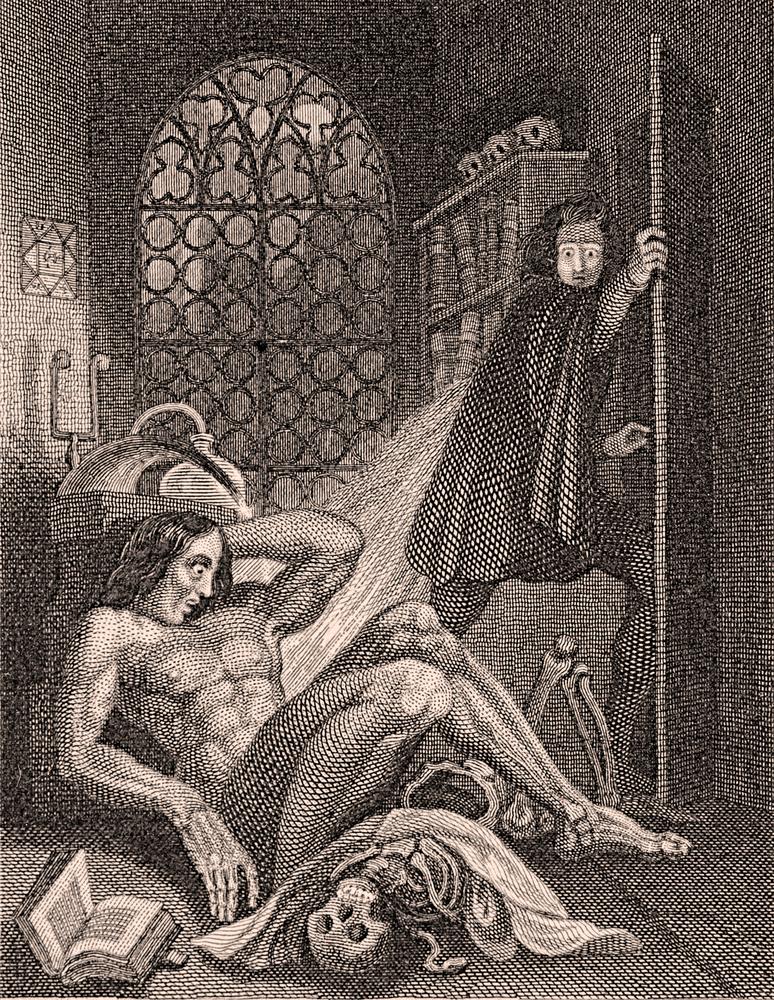
The 1831 Colburn & Bentley frontispiece, drawn by Theodor von Holst, is still the image most people mean when they say “the first Frankenstein picture”. A diagonal blade of light cuts the room in half. On the floor, the creature has just woken — long hair, classical muscle, one hand to his head — while Victor bolts for the door. A shrouded skeleton and a brace of skulls on the shelf do the moral arithmetic without a caption.
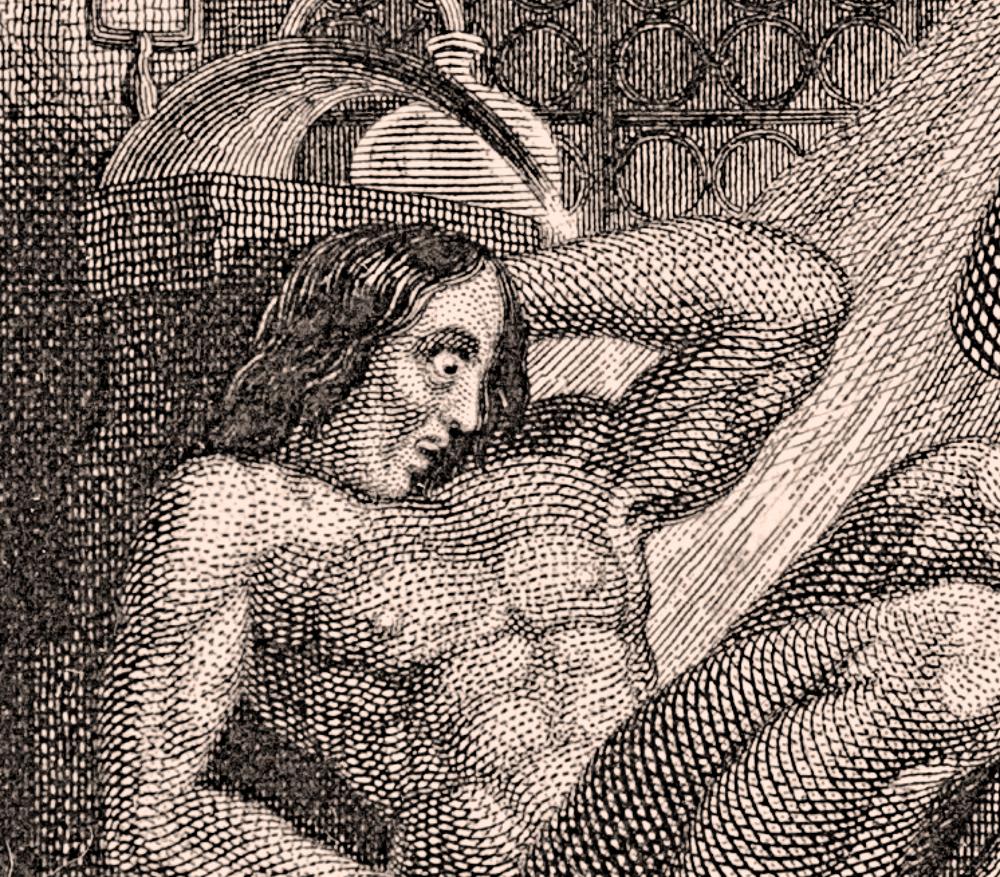
Look at the crop. Those deep blacks are not paint; they are engraved cross-hatching packed until the paper gives up. Highlights on the creature’s shoulder are stipple and thin open lines. That is how Gothic SF learned to look expensive on cheap paper — and why every later laboratory-monster poster still steals this composition. Read it: Frankenstein (Penguin Classics) (opens in a new tab) (Ad).
2. The War of the Worlds — H. G. Wells (1898)
Wells invents the invasion procedural: calm English counties, then heat-rays, then bureaucracy trying to keep the trains running while the sky falls. Locus 1998 #28. Every alien-landing news package still owes this book a pint. We are not reproducing a period plate here — the clean scans we found sat under our HD bar — but the Pearson-era illustrations are worth hunting in a library folio. The War of the Worlds (Penguin Classics) (opens in a new tab) (Ad).
3–4. Brave New World and Nineteen Eighty-Four
Huxley (1932) and Orwell (1949) split the dystopia franchise. Huxley sells comfort, conditioning and a pharmaceutical smile; Orwell sells the boot and the telescreen. Orwell is Locus 1998 #21; Huxley sits just outside that poll’s top ranks but owns the biotech-ethics bookshelf. If you work in surveillance, content moderation or behavioural advertising, you already speak both dialects.
Newcomer notes, because the titles get waved like flags. In Brave New World, babies are grown in bottles, castes are chemically set, and unhappiness is treated as a product defect — soma is the brand name for looking away. In Nineteen Eighty-Four, the Party rewrites the archive in real time and invents Newspeak so that dissent becomes grammatically awkward. One future is soft capture; the other is hard. Most modern platforms remix both. Brave New World (opens in a new tab) (Ad) · For Orwell, buy a complete text (not a school abridgement) and check the publisher page on the day — UK ISBNs churn.
5. Foundation — Isaac Asimov (1951–)
Psychohistory: treat a galactic empire like a gas, forecast its collapse, found a refuge to shorten the dark age. The Foundation novels topped the special 1966 Hugo for Best All-Time Series and sit at #4 on the 1998 Locus poll (as the trilogy). Cool rooms, long arguments, civilisation as a spreadsheet with feelings. Foundation (opens in a new tab) (Ad).
6–9. Fahrenheit 451, Childhood’s End, The Stars My Destination, Stranger in a Strange Land
Bradbury’s firemen (#29 Locus 1998) made book-burning feel like a municipal service — the state as a fire department that arrives when you open the wrong file. Clarke’s Childhood’s End (#8) is the overlord novel that still haunts UFO discourse: benevolent aliens, vanished children, transcendence with a bill attached. Bester’s The Stars My Destination (#6) is revenge as teleportation physics — “jaunting” by force of will, corporate war, a protagonist who rebuilds himself the way malware rebuilds a foothold. Heinlein’s Stranger in a Strange Land (#5, Hugo 1962) smuggled a Martian dictionary into the counterculture. Four different ideas of “changed the future”: censorship panic, first-contact theology, cybernetic willpower, and the word grok.
Fahrenheit 451 (opens in a new tab) (Ad) · Childhood’s End (opens in a new tab) (Ad) · The Stars My Destination (opens in a new tab) (Ad) · Stranger: any complete uncut edition you can verify.
10. Dune — Frank Herbert (1965)
Hugo and Nebula in 1966; #1 on the 1998 Locus all-time poll. Ecology as destiny, religion as statecraft, a desert that eats armies. If you have only seen the films, the book is slower, stranger and more interested in water accounting.
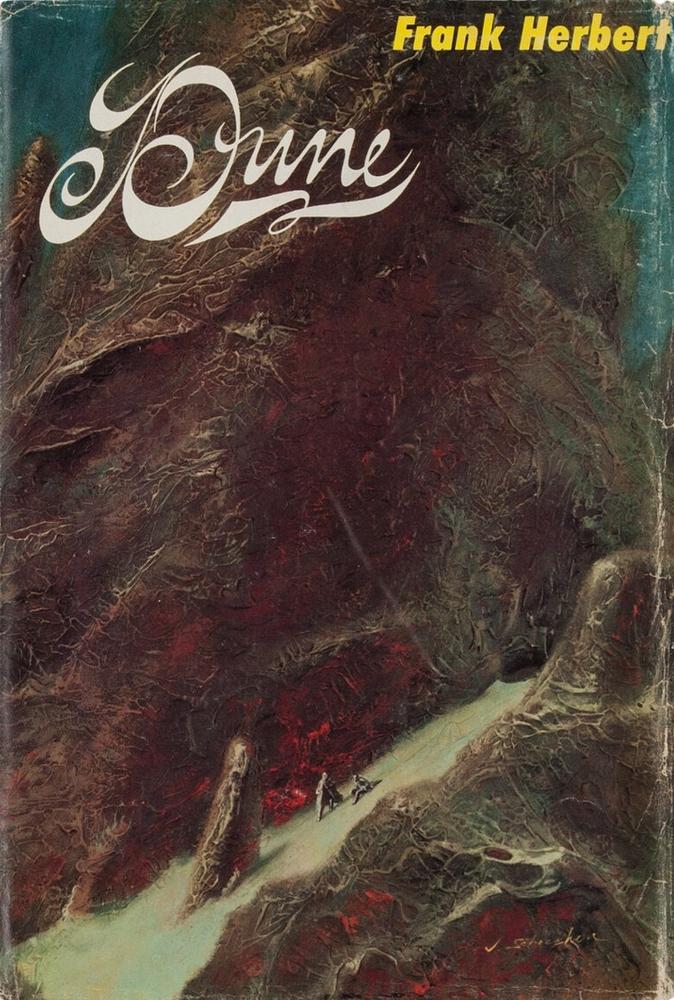
Schoenherr’s Chilton jacket is not the sandworm poster people expect. It is a cliff the colour of dried blood, painted with visible, almost crusty strokes, and two pale figures the size of punctuation marks on a path at the bottom. The title “Dune” arrives in white script with a looping D; “Frank Herbert” sits opposite in hard yellow sans-serif. That mismatch — romantic title, industrial author line — is the whole novel in typography.
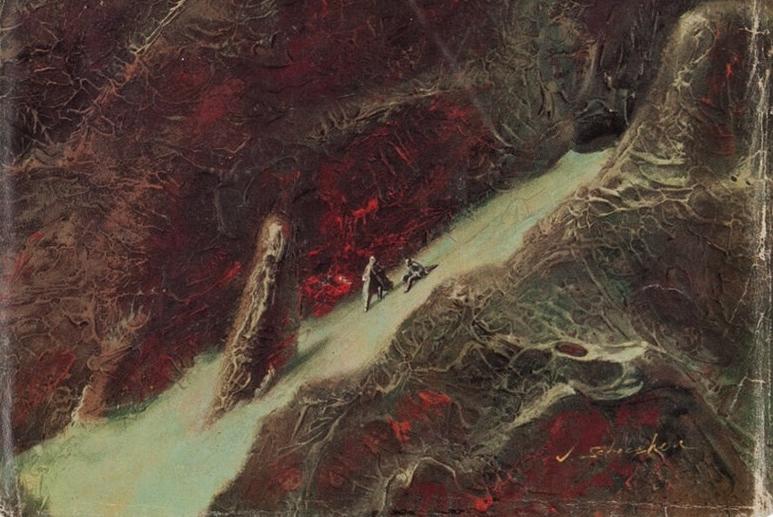
In the crop you can see how little information the humans get. They are silhouettes. The rock gets all the brushwork. Arrakis, on this jacket, is not an adventure playground; it is a wall that happens to have a footpath. Dune (opens in a new tab) (Ad).
11–15. Moon, Left Hand, Ringworld, Forever War, The Dispossessed
Heinlein’s The Moon Is a Harsh Mistress (#2 Locus 1998, Hugo 1967) is the lunar revolution novel with a sentient mainframe for a co-conspirator — still the cleanest popular explanation of why bandwidth and logistics beat slogans. Le Guin’s The Left Hand of Darkness (#3, Hugo and Nebula) made gender a planetary climate system; the Ace Special jacket by Leo and Diane Dillon is legendary, but we could not secure a clean HD original under our rules this pass, so no reproduction. Niven’s Ringworld (tied #25) is megastructure tourism with teeth. Haldeman’s The Forever War (#12, Hugo and Nebula) is Vietnam rewritten as time-dilation maths. Le Guin’s The Dispossessed (#19, Hugo and Nebula) is anarchism and physics sharing a wall calendar.
The Left Hand of Darkness (opens in a new tab) (Ad) · The Forever War (opens in a new tab) (Ad) · The Dispossessed (opens in a new tab) (Ad) · Moon / Ringworld: prefer SF Masterworks or equivalent complete texts.
If those titles are new: Harsh Mistress is a lunar colony that declares independence with the help of a self-aware computer nicknamed Mike — politics as network effect. Left Hand sends an envoy to a planet of ambisexual humans and asks what “gender” even measures. Ringworld puts explorers on an artificial ring around a star, then breaks their tourism. Forever War ships soldiers at near-light speed so that every homecoming is a century late — PTSD as relativity. The Dispossessed pairs an anarchist moon with a capitalist planet and refuses to let either side be cartoonishly pure.
16. Neuromancer — William Gibson (1984)
Hugo, Nebula and Philip K. Dick Award; #15 on Locus 1998. Console cowboys, ICE, the word cyberspace dragged out of the academy and into the mall. If you work in infosec, you have already inherited half its slang. James Warhola’s Ace Special cover — the gold-foil face and circuit horizon — is the one collectors mean. For newcomers: Case is a washed-up console cowboy hired to commit the kind of network crime that redefines “inside job”; Molly has mirrored lenses and blades under her nails; Wintermute is an AI with a staffing problem. Warhola is living and prints of his work circulate through galleries; under our rules that would cap any host file at 600px. We did not get a clean HD master we trusted, so we are not hosting it. Hunt the Ace first edition; then read the book. Neuromancer (S.F. Masterworks) (opens in a new tab) (Ad).
17–20. Ender’s Game, Hyperion, Snow Crash, The Three-Body Problem
Card’s Ender’s Game (#9 Locus 1998, Hugo and Nebula) turned child-soldier training into a simulation ethics problem every games designer still trips over. Simmons’s Hyperion (#10, Hugo 1990) is Canterbury Tales with a killing tree. Stephenson’s Snow Crash (1992) sits after the Locus cut-off; it still minted “metaverse” and popularised “avatar” in the virtual-reality sense for a generation of builders — see MIT Technology Review’s 8 February 2022 history of the idea (opens in a new tab), and NPR’s earlier reporting on science fiction as an engineering moodboard (21 August 2010 (opens in a new tab)). Liu Cixin’s The Three-Body Problem (English tr. Ken Liu, 2014; Hugo Best Novel 2015) put Chinese cosmic sociology on the global shelf overnight.
Ender’s Game (opens in a new tab) (Ad) · The Hyperion Omnibus (opens in a new tab) (Ad) · Snow Crash (opens in a new tab) (Ad) · The Three-Body Problem (opens in a new tab) (Ad).
Part 2 — Ten favourites (including the ones with the good posters)
The twenty above are the syllabus. These ten are the books and pictures we actually lend. Three were non-negotiable for this commission: Barsoom, Conan, and the Métal Hurlant / Heavy Metal visual storm. The rest lean cyber, systems and tech — explained for newcomers.
1. A Princess of Mars — Edgar Rice Burroughs (1912/1917)
John Carter wakes on Mars, fights green four-armed Tharks, falls for Dejah Thoris, and invents sword-and-planet fiction while he is at it. Soft science, hard swagger. Read it as pulp archaeology: every later planetary romance is paying rent.
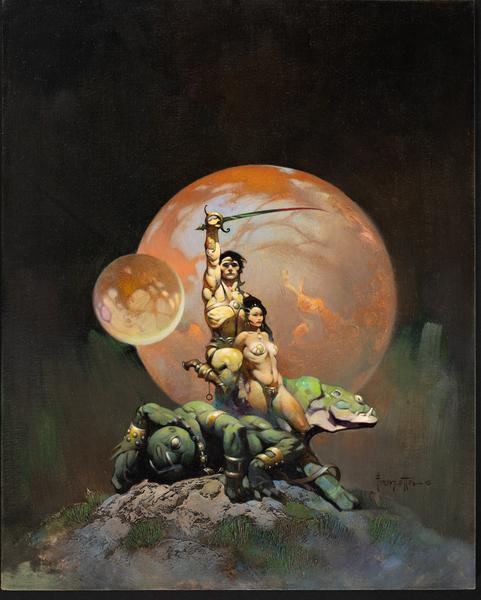
Frazetta’s 1970 Doubleday SFBC painting is a pyramid of bodies against a black sky. Carter at the apex with a curved sword; Dejah Thoris in gold harness; a defeated green Martian crumpled at the base; a thoat’s tusked head crowding the frame; an orange Mars disc stuck up like a stage light. The estate still sells fine-art prints of Frazetta’s work — which is why our web copy stops at 600 pixels on the long edge.
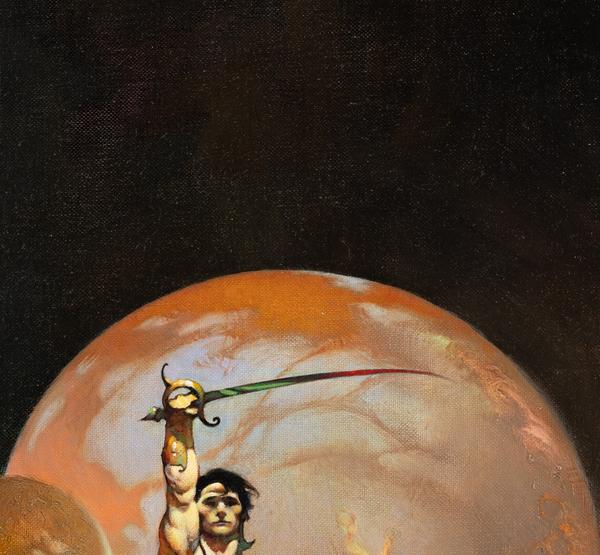
The crop is where the oil painting stops being a movie poster and starts being anatomy homework. Look at the specular hits on shoulder and cheek: short, opaque strokes. Edges dissolve into the black. That is how Frazetta made pulp look like museum stock without losing the sword. (No affiliate for art prints — buy from the estate if you buy.)
2. Conan — Robert E. Howard (Lancer-era Frazetta covers)
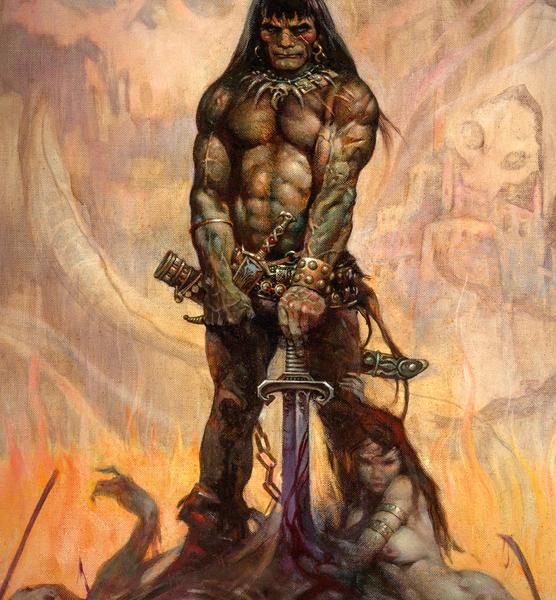
Howard’s Conan stories are depression-era barbarian noir: civilisation as a temporary mistake, strength as a moral argument. The Lancer paperbacks of the 1960s did not just reprint them; Frazetta’s covers relaunched the character for a generation that had never seen Weird Tales.
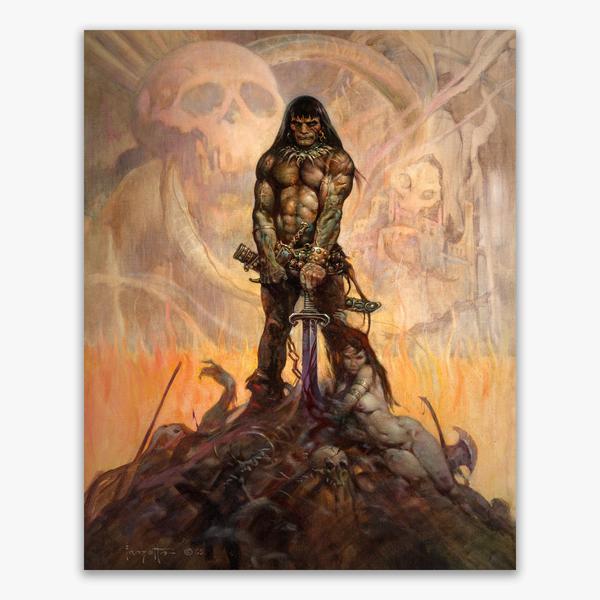
Plant the broadsword. Stack the dead. Put a giant skull in the smoke. Light Conan from the fire underneath so every muscle reads as a ridge map. The woman at his knee is period pulp politics we should not pretend away; the painting’s power is still the upward glow and the exhaustion in the stance. Again: estate prints exist, so 600px here.
A solid modern entry point: The Coming of Conan the Cimmerian (opens in a new tab) (Ad).
3. Heavy Metal / Métal Hurlant art — Moebius and company
Not a novel: a visual operating system. Paris, mid-1970s, Métal Hurlant; then the US magazine Heavy Metal. Moebius (Jean Giraud), Richard Corben and others taught cinema and games what “science fantasy” looked like when linework did the drugs. If you have ever storyboarded a canyon chase, you have paid tuition here.
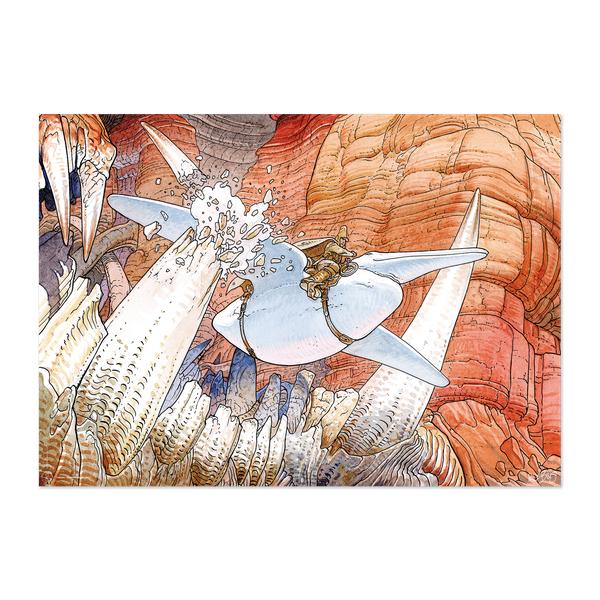
Arzak in the tall hat, cape flat in the slipstream, white flyer clipping a fossil spike while the canyon walls stripe themselves in terracotta. Moebius Production still sells posters and art prints of this world — 600px cap on our copy.
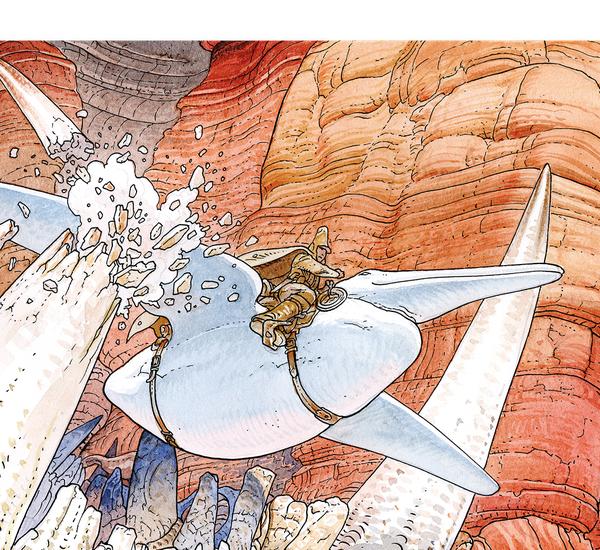
The crop is a masterclass in clear line: the explosion is dozens of tiny closed shapes, not a photoshop brush. Colour sits behind the ink like stained glass. That is why Heavy Metal frames still feel expensive when the plot is nonsense.
4. The Player of Games — Iain M. Banks (1988)
Best on-ramp to Banks’s Culture: a bored games genius is volunteered to represent a post-scarcity civilisation in an empire where a board game is the state. Minds (shipboard AIs) do the real politics offstage. If “utopia with dirty hands” means nothing to you yet, start here. The Player of Games (opens in a new tab) (Ad).
5. Do Androids Dream of Electric Sheep? — Philip K. Dick (1968)
Bounty hunter, fake animals, empathy tests, the nagging suspicion the tester is the test. The film Blade Runner is a cousin, not a photocopy. Do Androids Dream of Electric Sheep? (opens in a new tab) (Ad) · Blade Runner (film-tie edition of the novel) (opens in a new tab) (Ad).
6. Altered Carbon — Richard K. Morgan (2002)
Your mind is a cortical stack at the top of the spine; bodies are “sleeves” you can rent, buy or steal; death, for anyone who can afford a remote backup, is a pricing problem. Takeshi Kovacs is a washed-up envoy dropped into someone else’s murder on a decadent Earth. If Neuromancer taught networks to feel noir, Morgan taught immortality to feel like a subscription scam. Cyberpunk after the broadband bill came due. Altered Carbon (opens in a new tab) (Ad).
7. Blindsight — Peter Watts (2006; in Firefall)
First contact as a thesis that consciousness might be evolutionary malware — useful for bonding apes, expensive for dealing with truly alien intellects. The crew is a nightmare of specialists (including a synthesist who is barely a person in the usual sense); the aliens do not owe you a chat, a face or a motive you will like. Hard SF with the bedside manner of a coroner. UK readers can get Blindsight with its sequel in Firefall (opens in a new tab) (Ad).
8. Accelerando — Charles Stross (2005)
The Singularity told as three generations of increasingly illegible capitalism. Lobsters get uploaded and unionise; venture capital becomes a planetary weather system; grandchildren inherit problems that no longer fit inside a skull. The footnotes feel like exploit write-ups. If “posthuman” usually means shiny chrome, Stross means your spreadsheet has achieved orbit and stopped returning your calls. Accelerando (opens in a new tab) (Ad).
9. The Diamond Age — Neal Stephenson (1995)
Nanotech “matter compilers” sit in kitchens like microwave ovens; a stolen interactive book — the Young Lady’s Illustrated Primer — tries to raise a girl outside the caste her birth assigned. The question is who gets an education when atoms are cheap and culture is not. Pair with Snow Crash if you want Stephenson’s 1990s as a double feature: one book about streets and avatars, one about classrooms and feedstocks. UK paperback ASINs for Diamond Age move; search the title on Amazon UK and check the publisher page before you click — we are not risking a mismatched ASIN here.
10. Red Mars — Kim Stanley Robinson (1992)
Terraforming as committee work: scientists, corporations, revolutions and dust storms that do not care about your mission patch. Robinson treats Mars settlement as engineering plus labour politics plus ecology, which is why the trilogy still shows up in actual space-policy reading lists. If you think Mars is a poster, this is the planning application. Confirm the current UK ISBN on the retailer page; editions churn.
A short shelf if you only buy four
Dune (opens in a new tab) (Ad) for ecology-as-power; Neuromancer (opens in a new tab) (Ad) for the network nightmare that became a workplace; The Left Hand of Darkness (opens in a new tab) (Ad) for the social thought-experiment that still bites; The Three-Body Problem (opens in a new tab) (Ad) for the twenty-first-century cosmic panic. Then steal a Frazetta paperback from a relative and apologise later.
What the covers were for
Paperbacks are propaganda with a spine. Schoenherr sold loneliness; Frazetta sold impact; Moebius sold the dream logic that special-effects budgets still chase. Von Holst, a century earlier, sold the laboratory as a crime scene. The novels above changed the future by changing the metaphors engineers and voters reach for under pressure — cyberspace, metaverse, psychohistory, sleeve, stack, jaunte, grok. The jackets made sure you picked them up in a railway bookstall before any of those words were respectable. That is not trivial. That is distribution.
We will keep arguing about the syllabus. The prints, where estates still sell them, belong to the artists’ heirs — buy from them, not from random scrapers. Our copies stay small, credited and out of the social-image slots on purpose.
Opinion ends here. If a rights holder wants a credit tweak or a takedown on a reproduced image, email the usual Cyber-Threat.net contact — we will act fast.
Follow Cyber-Threat.net RSSFeedly (opens in a new tab)X (opens in a new tab)Bluesky (opens in a new tab)LinkedIn (opens in a new tab)