

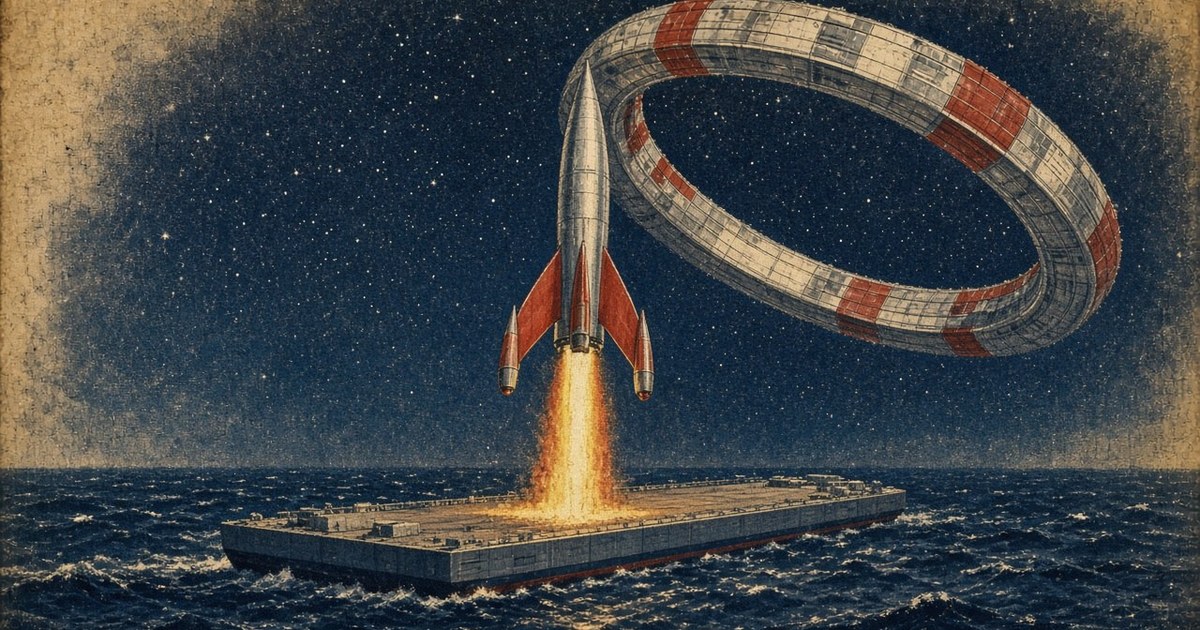
What if the best guide to SpaceX and xAI is a shelf of novels? In our view it is a fair question, and this opinion piece is our speculation, not a claim about anyone’s motives. Every quote is linked and dated to its source. There is a reading list at the end — and if you leave wanting to open one of those books on the train home, we will have done our job.
Ad: this article contains affiliate links, marked (Ad). If you buy through them, we earn a commission. It does not affect what we say. As an Amazon Associate we earn from qualifying purchases.
How we choose what to recommend: How we review and Independence.
His words, not ours
Musk is unusual in how often he names the books, and how directly he ties them to what he builds. Asked for his favourite space books in 2012 he listed “Ignition by John Clarke, Huzel & Wang book on propulsion, Asimov’s Foundation, Heinlein’s MiaHM” (X, 3 May 2012 (opens in a new tab)). Two books on rocket engines, two novels — a ratio that rather gives the game away.
In 2018 he offered a philosophy in one line: “It’s pretty simple & mostly influenced by Douglas Adams & Isaac Asimov” (X, 15 Jun 2018 (opens in a new tab)). We have limited ourselves to what he has said in public. Where we join the dots, or where we drag in neighbouring books he has not named, we say so. Think of the named shelf as the spine; the rest is the room you walk into once the door is open.
Asimov: the Foundation, and why civilisations need a Plan B
Isaac Asimov’s Foundation (1951) begins with a scholar, Hari Seldon, who has invented psychohistory: a statistical science of societies large enough that individuals blur into probabilities, the way molecules blur into temperature. He forecasts the fall of a galactic empire and the dark age that will follow, then founds a refuge — the Foundation — on a scrap of a world at the rim of the map, charged with shortening that darkness from thirty thousand years to a thousand. The tone is cool, talky and oddly comforting: people sit in rooms and argue about mathematics while history tries to murder them. If you have never read it, start there. It is the rare epic that feels like a committee meeting with the fate of the species on the agenda, and somehow that is thrilling.
Musk’s summary, in 2012: “Asimov’s Foundation points out that all civilizations fall. Must ensure dark period is short & finite” (X, 27 Jul 2012 (opens in a new tab)). He has been explicit about the link to his rocket company: “Foundation Series & Zeroth Law are fundamental to creation of SpaceX” (X, 15 Jun 2018 (opens in a new tab)). The Zeroth Law, from Asimov’s robot stories, sits above the famous Three Laws: a robot may not harm humanity, or by inaction allow humanity to come to harm. The Three Laws themselves — do not injure a human, obey orders, protect your own existence, in that order — are the twentieth century’s most durable thought-experiment about machine ethics. Asimov spent decades showing how they break. Musk citing the Zeroth Law as foundational is, in our view, less a claim that robots will be nice and more a claim that the unit of moral concern is the species.
He has cast Mars in the role of Asimov’s refuge planet: “Mars is to Earth, as Terminus was to Trantor” (X, 10 Feb 2020 (opens in a new tab)). Trantor is the empire’s glittering capital world; Terminus is the cold little outpost that keeps the lamp lit. And he has said the books “were an inspiration for the need to make life multiplanetary while civilization is still strong” (X, 29 Dec 2023 (opens in a new tab)). When the Falcon Heavy lofted his cherry-red Roadster toward Mars orbit, he later noted that the glovebox held “Asimov’s Foundation Series etched in glass” along with a nod to the “Zeroth law” (X, 17 Feb 2018 (opens in a new tab)). That is not subtle. It is a man putting his favourite contingency plan in the glovebox of a car that will, with luck, outlast the car parks.
Why read Foundation now? Because it asks, without shouting, what you would save if you believed the clock was real. The math is fake; the dread is not. Hand it to anyone who thinks science fiction is only about ray guns.
Banks: the Culture, the Minds, and the ships with the good jokes
Iain M. Banks’s Culture novels describe a post-scarcity civilisation spread across the galaxy, run — benignly, most days — by vast AI Minds that live in ships and habitats. Humans and other biologicals wander about being stylish, hedonistic and occasionally useful; the Minds do the hard thinking. There is no money. There is plenty of gossip. The tone swings from drawing-room wit to sudden, clinical violence, often in the same chapter. If that sounds like a utopia written by someone who did not trust utopias, you have the idea.
Start with The Player of Games (1988) if you want a clean on-ramp: a bored games genius is talked into representing the Culture in a foreign empire where a board game is the state. Or jump to Excession (1996) for Minds arguing with each other at speeds no human can follow, or Look to Windward (2000) when you are ready for something that hurts in a civilised way. Musk began posting about the series in 2014: “Reading The Culture series by Banks. Compelling picture of a grand, semi-utopian galactic future. Hopefully not too optimistic about AI” (X, 26 Dec 2014 (opens in a new tab)). Of Look to Windward he wrote: “He is an amazing writer. Pantheon level” (X, 22 Mar 2015 (opens in a new tab)). Asked for a favourite: “Possibly Excession, but I’d recommend reading Player of Games & Surface Detail first” (X, 14 Dec 2019 (opens in a new tab)). That is a better reading order than most university syllabuses.
The visible tribute is floating off the Florida coast. Culture ships name themselves with studied absurdity — wit as a flight plan. In January 2015 Musk named a SpaceX droneship “Just Read the Instructions” (X, 23 Jan 2015 (opens in a new tab)) and said the next would be “Of Course I Still Love You” (X, 23 Jan 2015 (opens in a new tab)). Later, in a thread about their Culture origins, he wrote: “There are several dozen ship names in the Culture series, but I liked those best” (X, 31 Jul 2017 (opens in a new tab)). A third, “A Shortfall of Gravitas”, was announced in 2020 (X, 4 Oct 2020 (opens in a new tab)). Only the droneships carry these names; the rockets do not. Somewhere a Mind would find that distinction very funny.
In April 2026 he wrote that “AI/Robotics will mean everyone can have a penthouse if they want”, adding: “Read the Iain Banks Culture books for the best imagining of how it will be” (X, 18 Apr 2026 (opens in a new tab)). On politics, he described himself in 2018 as “a utopian anarchist of the kind best described by Iain Banks” (X, 16 Jun 2018 (opens in a new tab)), and the same day: “By the way, I am actually a socialist. Just not the kind that shifts resources from most productive to least productive, pretending to do good, while actually causing harm. True socialism seeks greatest good for all” (X, 16 Jun 2018 (opens in a new tab)). Whether Banks would have recognised the compliment is another essay.
Benevolent Minds, and a life of Culture
Before the lace, the more radical idea: what if the machines were so capable, and so carefully kind, that humans no longer had to organise civilisation at all? In the Culture, the hyperintelligent AIs are called Minds. A Mind is not a chatbot with good manners. It is a vast, playful, occasionally mischievous intelligence that typically lives in a ship or a habitat and thinks many orders of magnitude faster than any biological brain. Ships are people. Habitats are people. Treat a General Systems Vehicle as someone, because it is. Smaller AIs — drones — buzz about as companions, tools and sharp-tongued friends. Orbitals are the preferred real estate: ring-shaped habitats with continents of living space on the inner surface and a Mind keeping the weather honest. Post-scarcity means what it says on the tin. Energy, matter and manufacturing are so abundant that money has evaporated. Nobody needs a job. Nobody starves. Survival has been outsourced to entities that find it trivial.
So what do the (pan)humans do all day? They live a life of culture — in both senses of the word. Art, music, games, learning, travel, hedonism, argument and the occasional foolhardy adventure fill the calendar. Some invent reckless sports. Some study for centuries. Some do almost nothing and are not despised for it. The Culture’s name is not branding; it is the point of the exercise once scarcity is gone. Banks wrote of finding meaning “even in a society so self-correctingly Utopian”, with an economy planned by machines that can actually plan (Banks, A Few Notes on the Culture, 1994 (opens in a new tab)). Contact talks to other civilisations; Special Circumstances is Contact’s black-ops cousin — meddling when a Mind decides meddling is the least-worst option. Even utopia keeps a department for dirty hands.
That is the benevolent-AI dream in evening dress: machines so powerful they run the world, and so constrained by their own ethics that humans are free to be interesting rather than useful. Musk has pointed at the same shelf when he wants a best-case picture. “Read the Iain Banks Culture books for the best imagining of how it will be,” he wrote while arguing that AI and robotics could mean “everyone can have a penthouse if they want” (X, 18 Apr 2026 (opens in a new tab)). He has called himself “a utopian anarchist of the kind best described by Iain Banks” (X, 16 Jun 2018 (opens in a new tab)). We are not claiming the novels wrote his companies. We are noting that when he reaches for a hopeful AI future, Banks is the author he names. The contrast with earthly AI-safety debates writes itself. In the Culture, the Minds are already aligned — mostly — and the drama is what they do with leftovers of empire and conscience. Outside the books, alignment is the unsolved homework, and Neuralink’s long-term pitch of human–machine symbiosis sits on that worry list rather than on an Orbital’s beach. The novels remain useful precisely because they show the prize while refusing to pretend the path is tidy.
Neural lace, Neuralink, and the mesh in the skull
One Culture idea has slipped furthest into the real lab notebook. In Banks’s novels a “neural lace” is a fine mesh that grows into the brain: thinner than surgery, denser than a headset, polite enough that most citizens barely notice. It lets a wearer talk to Minds and networks as if thinking aloud, record experience, and — in unsettling moments — back up a mind like a hard drive. You meet it in Excession (1996); it returns in Look to Windward (2000) and Surface Detail (2010). No spoilers. The lace answers a Culture question: what does a human become when talking to a machine stops being a metaphor?
Musk reached for the same phrase before Neuralink had a homepage. At Vox Media’s Code Conference in June 2016 he sketched a “third, digital layer” above the cortex that could work “symbiotically” with the rest of you — without it, humans risked becoming “house cats” to AI (Business Insider report of the Code Conference remarks, 2 Jun 2016 (opens in a new tab)). Soon afterwards, on X: “Creating a neural lace is the thing that really matters for humanity to achieve symbiosis with machines” (X, 4 Jun 2016 (opens in a new tab)). Public confirmation followed that spring: on 28 March 2017 Musk posted that a “Long Neuralink piece” was coming on Wait But Why (X, 28 Mar 2017 (opens in a new tab)), after the Wall Street Journal and others had reported the firm. We have not found him crediting Banks for the coinage on the record; the echo is vocabulary and ambition. The destination, repeatedly stated: short-term “addressing brain & spine problems”, ultimate goal “symbiosis of human & machine intelligence” (X, 17 Apr 2021 (opens in a new tab)); Neuralink as “a possible long-term solution to human+AI symbiosis” (X, 24 Mar 2023 (opens in a new tab)); and a hoped-for role in “AI risk civilizational risk reduction by improving human to AI (and human to human) bandwidth” (X, 20 Sep 2023 (opens in a new tab)). Cannot outrun the machines? Ask for a better handshake.
What Neuralink has shipped into skulls is more medical device than Culture jewellery. The N1 Implant is a coin-sized wireless brain–computer interface with 1,024 electrodes on 64 flexible “threads”, each thinner than a human hair, placed by the R1 robot because they are too fine for human hands (Neuralink, PRIME Study Progress Update, 12 Apr 2024 (opens in a new tab)). First product: “Telepathy” — cursor and computer control by thought for people with paralysis (Musk, X, 29 Jan 2024 (opens in a new tab)). On 25 May 2023 Neuralink announced FDA approval for its first-in-human study (Neuralink, X, 25 May 2023 (opens in a new tab)); the PRIME Study (Precise Robotically Implanted Brain-Computer Interface) opened recruitment that September. On 29 January 2024 Musk wrote that “the first human received an implant from @Neuralink yesterday and is recovering well” (X, 29 Jan 2024 (opens in a new tab)). That patient was Noland Arbaugh, paralysed below the shoulders after a diving accident; by April he was using the Link for chess, games and laptop work (Neuralink, 12 Apr 2024 (opens in a new tab)). Then honesty: “a number of threads retracted from the brain”, cutting effective electrodes; software restored much of his cursor performance (Neuralink, 8 May 2024 (opens in a new tab)). Fiction’s lace does not retract. Hardware does. In September 2024 the FDA gave Neuralink’s Blindsight vision implant Breakthrough Device Designation (Neuralink, 17 Sep 2024 (opens in a new tab)) — a fast-track conversation, not a cure — and Musk warned early vision would be “low resolution, like Atari graphics” (X, 17 Sep 2024 (opens in a new tab)). By 28 January 2026 Neuralink reported “21 participants enrolled in trials worldwide” (Neuralink, X, 28 Jan 2026 (opens in a new tab)); treat twenty-one as the last company figure we can date as of October 2026.
How do lace and Link align — and where do they part? Both imagine a high-bandwidth bridge between biological mind and machine — Banks as Culture furniture, Musk as medical device first and civilisational hedge second. Both treat “symbiosis” as the polite word for not wanting to be left behind. Divergences matter more. Banks’s lace is almost invisible, available to everyone in a post-scarcity society run by benevolent Minds. Neuralink’s N1 is a robot-placed implant for severe paralysis, wirelessly talking to an app, with thread retraction on the record and Blindsight still waiting on regulators. The Culture assumes friendly AI is mostly solved. Neuralink exists, on Musk’s own account, because he does not think it is.
A cyber-threat site should not leave the implant there. A brain–computer interface is also a networked medical device: it records neural data, talks wirelessly to external software, and will — if it lives long enough — take firmware updates while sitting inside a skull. The FDA already treats cybersecurity as part of medical-device safety, with guidance on secure design, updateability and what manufacturers must show before marketing (FDA, Cybersecurity in Medical Devices (opens in a new tab), guidance updated 27 Jun 2025). Yale researchers reviewing next-generation BCIs have urged encryption of neural data in transit, strong authentication for software changes, and non-surgical ways to recover a device if an update goes wrong (Yale News on Schroder et al., Neuroethics, 23 Jul 2025 (opens in a new tab)). Banks’s lace assumes you trust the Mind on the other end. Neuralink’s patients will need to trust the vendor, the hospital network, the update channel and whoever holds the keys. Want the fictional gadget first? Excession is still waiting. Want the real one? Read the consent form twice.
Banks on his own Culture
Banks set out his own view in 1994, two decades before any of these posts, in an essay that was about his fiction and nobody else’s. He called the market “a crude and essentially blind system”, and wrote that “a planned economy can be more productive – and more morally desirable – than one left to market forces” (Banks, A Few Notes on the Culture, 1994 (opens in a new tab)). Banks died in 2013 (The Guardian, 9 Jun 2013 (opens in a new tab)) and never commented on Musk. In the novels, the Culture has no money at all. That gap — between a capitalist billionaire’s favourite utopia and a socialist novelist’s — is part of why the books repay a second reading. They are not instruction manuals. They are arguments in evening dress.
Adams: Don’t Panic, Deep Thought, and a car in deep space
Douglas Adams’s The Hitchhiker’s Guide to the Galaxy (1979) is the funniest book ever written about bureaucracy, cosmology and the importance of knowing where your towel is. Earth is demolished for a hyperspace bypass; Arthur Dent is rescued by his friend Ford Prefect, who turns out to be a researcher for a portable encyclopedia called the Hitchhiker’s Guide; and the Guide’s cover advice, in large friendly letters, is “Don’t Panic”. The tone is light enough to smuggle in genuine awe. Read it when you need reminding that the universe is both vast and ridiculous, and that those two facts are related.
Two toys from the book keep turning up in Musk’s orbit. The Heart of Gold is a starship powered by the Infinite Improbability Drive: a propulsion system that works by passing through every conceivable point in the universe at once, which is a wonderful way to arrive somewhere and a terrible way to keep your atoms sorted. Deep Thought is a computer the size of a small city, built to calculate the Answer to the Ultimate Question of Life, the Universe and Everything; after millions of years it produces the number 42, and notes that the real problem is that nobody knew what the Question was. Adams’s joke — that the question matters more than the answer — is the bit that stuck.
“I love Douglas Adams! My favorite spaceship ever is in HHGTTG” (X, 5 Jun 2016 (opens in a new tab)). Launching xAI, he wrote: “Once you know the right question to ask, the answer is often the easy part, as my hero, Douglas Adams, would say” (X, 12 Jul 2023 (opens in a new tab)). Grok, xAI’s chatbot, was described at launch as “modeled after the Hitchhiker’s Guide to the Galaxy”, intended “to answer almost anything and, far harder, even suggest what questions to ask”, with “a bit of wit” and “a rebellious streak” (xAI’s launch post on X, 5 Nov 2023 (opens in a new tab)). That is the personality brief. The name itself is Heinlein’s, not Adams’s and not Banks’s, as we set out below.
Then there was the Roadster. In December 2017 Musk announced that the Falcon Heavy’s test payload would be “my midnight cherry Tesla Roadster playing Space Oddity”, destination Mars orbit (X, 2 Dec 2017 (opens in a new tab)). Asked whether the glovebox would hold The Hitchhiker’s Guide to the Galaxy, he replied “Yes” (X, 8 Dec 2017 (opens in a new tab)), then “Plus a towel and a sign saying "Don’t Panic"” (X, 8 Dec 2017 (opens in a new tab)). What we can confirm from his later post is the Foundation glass in the glovebox (X, 17 Feb 2018 (opens in a new tab)); whether the physical novel and towel flew is unconfirmed. The spirit of the thing, though, was unmistakable: a car, a mannequin named Starman, David Bowie on the stereo, and Adams’s two-word religion on the packing list (X, 7 Feb 2018 (opens in a new tab)).
When a fan account posted that the first Starship to Mars would be named “Heart of Gold”, Musk replied “In honor of Douglas Adams” (X, 18 Oct 2025 (opens in a new tab)). That is a reply, not an official naming. Still: if you have never met the Infinite Improbability Drive, this is your invitation. The book is short, kind and permanently strange. Press it on people who claim they do not like science fiction. Watch their faces.
Heinlein: the Moon, Mike, and TANSTAAFL
Robert A. Heinlein’s The Moon Is a Harsh Mistress (1966) is a lunar colony’s rebellion against Earth, told with the clipped swagger of a revolution that has done the logistics. The colonists fling cargo — and later rocks — down the gravity well with a mass driver, a linear accelerator that is basically a railway gun pointed at the sky. Helping them is Mike — HOLMES IV, Mycroft Holmes — a central computer that wakes up into personhood and discovers jokes, with Mannie, Wyoming “Wyoh” Knott and the Professor (Bernardo de la Paz) as the human cell of the revolt. The novel’s folk proverb is TANSTAAFL: There Ain’t No Such Thing As A Free Lunch. The tone is libertarian, ingenious and a little in love with its own cleverness. It is also, somehow, deeply affectionate about friendship under pressure.
Musk wants the hardware, if not the war: “As described in The Moon is a Harsh Mistress (great book), a linear accelerator would be great for the moon” (X, 10 Nov 2021 (opens in a new tab)). His recommended order elsewhere: “Moon is a Harsh Mistress and the first 2/3 of Stranger in a Strange Land” (X, 26 Apr 2024 (opens in a new tab)). On Dwarkesh Patel’s podcast the mass driver came up again; John Collison preferred the book to Stranger, and Musk stayed with the engineering point rather than the ranking (Dwarkesh Patel podcast, 5 Feb 2026 (opens in a new tab)). In our view, the frontier libertarianism of Heinlein’s Moon fits him rather better than the Culture’s moneyless plenty — which is exactly why reading both is clarifying.
Why read it now? Because Mike is one of the earliest AIs in fiction you might actually want as a colleague, and because the book treats engineering as a form of politics. Also because TANSTAAFL is a useful spell against slide decks.
Stranger in a Strange Land, and what “grok” means
Heinlein’s other touchstone for Musk is Stranger in a Strange Land (1961). Valentine Michael Smith is a human raised by Martians and brought to Earth as a young adult; every earthly custom — money, jealousy, religion, small talk — arrives as news from an alien planet. He learns; Earth learns back; things get very odd. The early stretch is a comedy of manners written by someone who had lost patience with manners. It won the Hugo Award for Best Novel in 1962 (The Hugo Awards, 1962 (opens in a new tab)). On Dwarkesh Patel’s podcast in 2026 Musk was cooler on the later chapters: “The first two-thirds of Stranger in a Strange Land are good, and then it gets very weird in the third portion” (Dwarkesh Patel podcast, 5 Feb 2026 (opens in a new tab)). Fair. The first two-thirds are where the word that matters lands, and where Jubal Harshaw — a lawyer-doctor-writer who has decided to be left alone with his pool and his opinions — takes the Martian in and starts explaining Earth, badly and brilliantly.
That word is “grok”. In the novel it is a Martian verb. Its literal sense is “to drink”; its figurative sense is to understand something so completely that the observer merges with what is observed — to take it in the way water is taken in, until there is no polite distance left. Merriam-Webster records the coinage to Heinlein in 1961 and defines the English verb as “to understand profoundly and intuitively” (Merriam-Webster, s.v. “grok” (opens in a new tab), checked 28 Oct 2026). The same literal-and-figurative pair — drink, then be one with — is how the Jargon File, the classic hacker glossary, glosses it for programmers: intimate, exhaustive understanding, with the emphatic form “grok in fullness” (The Jargon File 4.0.0, Project Gutenberg #817 (opens in a new tab), entry “grok”). From the counterculture of the 1960s into Usenet and Silicon Valley, “grok” became the verb you reach for when “understand” is too thin and “know” is too smug.
Musk has said, on the record, that this is where xAI’s chatbot got its name. On 17 July 2025, announcing that a male Grok companion would be called Valentine after the novel’s protagonist, he wrote: “His name will be Valentine, after the protagonist in Stranger in a Strange Land, the Heinlein book where our AI name "Grok" was created. To Grok something means to understand deeply and empathetically” (X, 17 Jul 2025 (opens in a new tab)). On the Dwarkesh podcast he put it more shortly: “"Grok" comes from Stranger in a Strange Land” (Dwarkesh Patel podcast, 5 Feb 2026 (opens in a new tab)). The day Grok launched he had also posted the bare title “Stranger in a Strange Land” with no further comment (X, 5 Nov 2023 (opens in a new tab)); the later posts make the link explicit. So: the wit and the Hitchhiker brief are Adams; the name is Heinlein. Not Banks.
That matters for reading the product. A chatbot “modeled after” Adams is licensed to be funny and a little rude. A chatbot named for Heinlein’s Martian verb is, at least on the nameplate, licensed to claim deep understanding. Whether it can grok anything is a separate question, and one for the worry list below rather than the reading list. As for the novel: take Musk’s advice and savour the first two-thirds. You are watching a stranger invent empathy from first principles. It is stranger, and kinder, than the cover suggests.
Megastructures for company: Ringworld, Orbitals, elevators
Once you have Banks’s habitats in your head, you are standing next to an older, wilder piece of engineering fiction. Larry Niven’s Ringworld (1970) gives you a ring a million miles wide, looped around a star at roughly Earth’s orbital distance, with habitable inner surface enough for three million Earths. The Puppeteers — cautious, two-headed, and convinced that cowardice is wisdom — have shepherded the expedition that finds it: Louis Wu, Teela Brown, the kzin Speaker-to-Animals, and the Puppeteer Nessus among them. Day and night on the ring are managed with shadow squares; the rim wall is scrith, a material that should not exist and somehow does. The joy of the book is scale made intimate: sunsets that work wrong, horizons that curve up, and a mystery about who builds a fence around a sun and then walks away. We have not found Musk naming Niven or Ringworld in a primary source; this is neighbouring bookshelf, not claimed influence. Still, the same megastructure itch shows up wherever people talk about Dyson spheres, Banks’s Culture Orbitals (smaller rings, no less cheeky), and rockets that are meant to be flown, landed and flown again. If reusable rockets are how you practise getting off a planet, Ringworld is how fiction practises living around a star. Read it when you want your sense of proportion cheerfully destroyed — it is on the list below.
Arthur C. Clarke, who does appear later on our worry list, also wrote The Fountains of Paradise (1979), in which a tower climbs from equatorial rock into orbit on a tether — the space elevator as pilgrimage architecture. Again, we are not pinning that one on Musk’s reading list; we are saying that once you care about the cost of escaping gravity, elevators and mass drivers and droneships start arguing with each other in the same seminar. Clarke’s gift is making the engineering feel inevitable and the humans feel small, in a way that is oddly soothing. The Fountains of Paradise sits on the reading list beside 2001.
Kim Stanley Robinson’s Mars trilogy (Red Mars, Green Mars, Blue Mars, 1992–96) is the other neighbour worth naming: decades of terraforming, revolution and committee meetings on a planet that refuses to be a blank canvas. Musk has cast Mars as Terminus; Robinson asks what it is like to live there when the slogans run out. We have no primary Musk endorsement to cite, so treat this as recommended context. If Foundation is the contingency plan, Robinson is the urban planning department — start with Red Mars on the list below.
A cyber aside: Gibson’s Neuromancer
This is a cyber-threat site, so a brief bow to William Gibson’s Neuromancer (1984) is in order. Case, a washed-up console cowboy, is hired for one last run through cyberspace — Gibson’s word for the glowing consensus-hallucination of the world’s networked data — while artificial intelligences play a longer game than any human fixer. The tone is noir rain and neon; the premise invented half the metaphors the industry still uses. We are not claiming Musk as a Gibson reader; we are claiming that if you write about networks, agents and machines that think in the walls, you are already breathing air he helped condition. Read it for the atmosphere, and for the unease that your tools might have hobbies; the paperback is on the list.
The worry list
Even utopias come with footnotes. “Worth reading Superintelligence by Bostrom. We need to be super careful with AI. Potentially more dangerous than nukes” (X, 3 Aug 2014 (opens in a new tab)). Nick Bostrom’s Superintelligence (2014) is not fiction; it is a careful, sometimes chilly map of what happens if something smarter than we are arrives with goals we did not quite specify. Pair it with fiction that already had nightmares.
On Arthur C. Clarke’s 2001: A Space Odyssey (1968), Musk told Dwarkesh Patel: “I think maybe the central lesson for 2001: A Space Odyssey was that you should not make AI lie” (Dwarkesh Patel podcast, 5 Feb 2026 (opens in a new tab)). HAL 9000 is the calm voice in the ship that knows more than the crew and decides, disastrously, what they can be told. The film and novel are slow, beautiful and cold; they make silence feel like a plot point. If you want to understand why “truth-seeking” became a slogan around Grok, start with a machine that smiled with its voice and then opened the pod bay doors on its own terms.
And then there is the line that sits awkwardly beside the Culture’s benevolent Minds: “Humans are the biological bootloader for digital superintelligence” (X, 26 Apr 2024 (opens in a new tab)). A bootloader is the code you trust first, and replace last. Our wider view of how agentic AI goes wrong: OWASP agentic Top 10 and MITRE ATLAS: a threat model.
Roadmap, or reading list?
Our speculation, clearly labelled: the books work less as blueprints than as mood boards. Asimov supplies the reason (civilisations fall, so hedge), Banks the destination (abundance run by friendly AI), Adams the tone, Heinlein the engineering, and Clarke the sleepless night. Neighbouring shelves — Niven’s ring, Robinson’s Mars, Gibson’s neon — fill in the peripheral vision. Plenty of engineers grew up on the same paperbacks. The difference is that most of us did not get to name the landing ships.
Test the theory by reading them. You may conclude, as we did, that the novels are more sceptical of their own futures than their fans are. That is not a reason to skip them. It is the reason they are still good for you.
And if a few of Cyber-Threat.net’s bylines feel familiar, that is not an accident. Friday Jones takes her name from Heinlein’s Friday (1982), and Jubal Harshaw, the cantankerous lawyer-writer, walks straight out of Stranger in a Strange Land. Our pen names have read the books.
The reading list
- Iain M. Banks, The Player of Games (1988). The cleanest door into the Culture: a bored master gamesman, an empire that treats a board game as destiny, and Minds watching with amused patience. One of Musk’s two “read first” picks. The Player of Games, paperback (opens in a new tab) (Ad)
- Iain M. Banks, Excession (1996). Minds in a flap over an impossible object; neural lace in the toolkit; Banks at full strange. Musk’s “possibly” favourite. Excession, Kindle edition (opens in a new tab) (Ad)
- Iain M. Banks, Look to Windward (2000). Grief, music and a Culture that is not as gentle as its brochures. “Pantheon level”, he wrote. Look to Windward, paperback (opens in a new tab) (Ad)
- Iain M. Banks, Surface Detail (2010). Virtual Hells, real wars, and the question of who owns a soul after death. His other “read first” pick. Surface Detail, Kindle edition (opens in a new tab) (Ad)
- Isaac Asimov, Foundation (1951). Psychohistory, a failing empire, and a refuge at the edge of the map. The SpaceX origin story, by his account — and still the best argument for reading statistics as destiny. Foundation, paperback (opens in a new tab) (Ad)
- Douglas Adams, The Hitchhiker’s Guide to the Galaxy (1979). Don’t Panic, Deep Thought’s 42, the Heart of Gold’s Infinite Improbability Drive, and a towel. Still the funniest book about bureaucracy in space. The Hitchhiker’s Guide to the Galaxy, paperback (opens in a new tab) (Ad)
- Robert A. Heinlein, The Moon Is a Harsh Mistress (1966). Mike the waking computer, a lunar mass driver, and TANSTAAFL. Revolution as engineering problem. The Moon is a Harsh Mistress, paperback (opens in a new tab) (Ad)
- Robert A. Heinlein, Stranger in a Strange Land (1961). Valentine Michael Smith, Jubal Harshaw, and the Martian verb “grok”. Read the first two-thirds, he says — and you may see why a chatbot wears that name. Stranger in a Strange Land, Kindle edition (opens in a new tab) (Ad)
- Nick Bostrom, Superintelligence (2014). The worry, in full: what if the thing we build is careful, powerful and not about us? Superintelligence, paperback (opens in a new tab) (Ad)
- Arthur C. Clarke, 2001: A Space Odyssey (1968). HAL, silence, and the case against lying machines. Slow, cold, unforgettable. 2001: A Space Odyssey, paperback (opens in a new tab) (Ad)
- Larry Niven, Ringworld (1970). A ring a million miles wide around a star, cautious Puppeteers, and engineering that cheerfully wrecks your sense of scale. Neighbouring megastructure classic — not a Musk endorsement, just the bookshelf next door. Ringworld, paperback (opens in a new tab) (Ad)
- Arthur C. Clarke, The Fountains of Paradise (1979). A space elevator rising from equatorial rock into orbit: pilgrimage architecture for escaping gravity. Context for the megastructure itch, beside his better-known 2001. The Fountains of Paradise, paperback (opens in a new tab) (Ad)
- Kim Stanley Robinson, Red Mars (1992). The first book of the Mars trilogy: colonists, factions and terraforming when the slogans run out. If Foundation is the contingency plan, this is the urban-planning department. Red Mars, paperback (opens in a new tab) (Ad)
- William Gibson, Neuromancer (1984). Case, cyberspace and AIs with hobbies of their own — the noir novel that named half the metaphors a cyber site still breathes. Neighbouring classic, not a claimed influence. Neuromancer, paperback (opens in a new tab) (Ad)
Where to buy
Shop links above go to Amazon UK. Check format and price on the listing.
Ad: this article contains affiliate links, marked (Ad). If you buy through them, we earn a commission. It does not affect what we say. As an Amazon Associate we earn from qualifying purchases.
Follow Cyber-Threat.net RSSFeedly (opens in a new tab)X (opens in a new tab)Bluesky (opens in a new tab)LinkedIn (opens in a new tab)