



ALERT · Patch available. Not known exploited. Last updated 29 October 2026. See the Alert Tracker
If your developers or pipelines run the OpenHands coding agent in Docker or Apptainer sandboxes, check today whether anything other than the host itself can reach those sandboxes. CVE-2026-112346 means that, before version 1.52.0 of the OpenHands Software Agent SDK, anyone who could reach a sandbox’s port could run shell commands in it as root and read the secrets it holds, without a password. Upgrading fixes how Docker publishes the port. It does not turn authentication on, so set a session key as well.
What it is
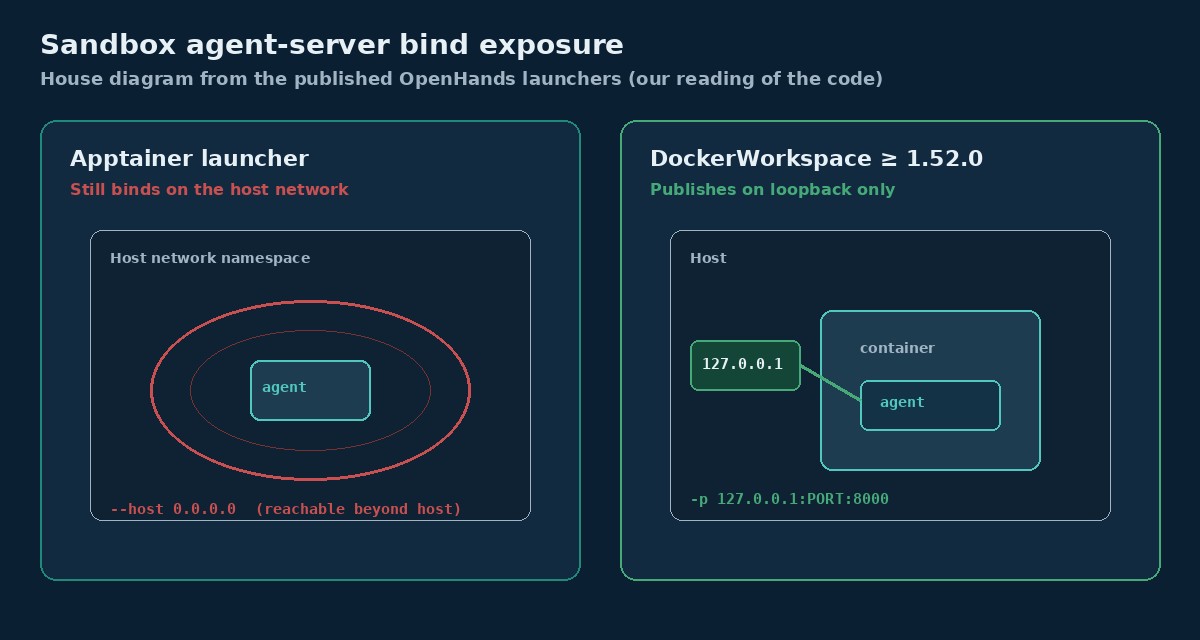
OpenHands is an open-source AI coding agent. Its Software Agent SDK runs the agent inside a sandbox: a container with a small web server, the “agent server”, which the agent and the developer’s tools use to run commands, read and write files, and fetch stored secrets. That server is the remote control for the sandbox.
The CVE record (opens in a new tab), published on 26 October by VulnCheck as the CVE Numbering Authority (CNA), says the DockerWorkspace and Apptainer workspace launchers “bind the sandbox agent server to all network interfaces (0.0.0.0) with an empty session_api_keys list, disabling authentication by default.” It goes on: “Attackers who can reach the published container port can send unauthenticated HTTP and WebSocket requests to execute arbitrary shell commands as root in the sandbox, access the mounted workspace, and read plaintext secrets from the secrets store.”
Put simply, it is an open door rather than a clever bug. The mounted workspace is usually a real code checkout, and the secrets store is where API keys and tokens for the agent are kept.
Scores
- CNA (VulnCheck): CVSS 4.0 9.3, Critical (
AV:N/AC:L/AT:N/PR:N/UI:N/VC:H/VI:H/VA:H/SC:N/SI:N/SA:N), and CVSS 3.1 9.8, Critical. Weakness CWE-1327, binding to an unrestricted IP address. - NVD: awaiting analysis when we checked.
- EPSS: 0.01014 (about 1.0%; 63rd percentile) on the 28 October 2026 score date.
Is it being exploited?
Not as far as anyone has said. CVE-2026-112346 is not in CISA’s Known Exploited Vulnerabilities catalogue (opens in a new tab) (version 2026.10.28), and VulnCheck’s advisory (opens in a new tab) does not report attacks. There is no separate advisory from the OpenHands project. Using it needs no skill, though: anyone who finds an open sandbox can use the server’s own documented API, so treat exposure as the risk.
Who is affected
You are affected if you use the OpenHands Software Agent SDK (the Python packages openhands-sdk, openhands-workspace and openhands-agent-server) before 1.52.0 with the DockerWorkspace or Apptainer launcher, on a machine that other machines can reach. That covers shared development servers, cloud VMs with open security groups, CI runners and research clusters. A laptop on a shared office or café network counts too. The record names only the SDK. It does not say whether the OpenHands web app or OpenHands Cloud are affected, and we have not tested them.
Fixed versions
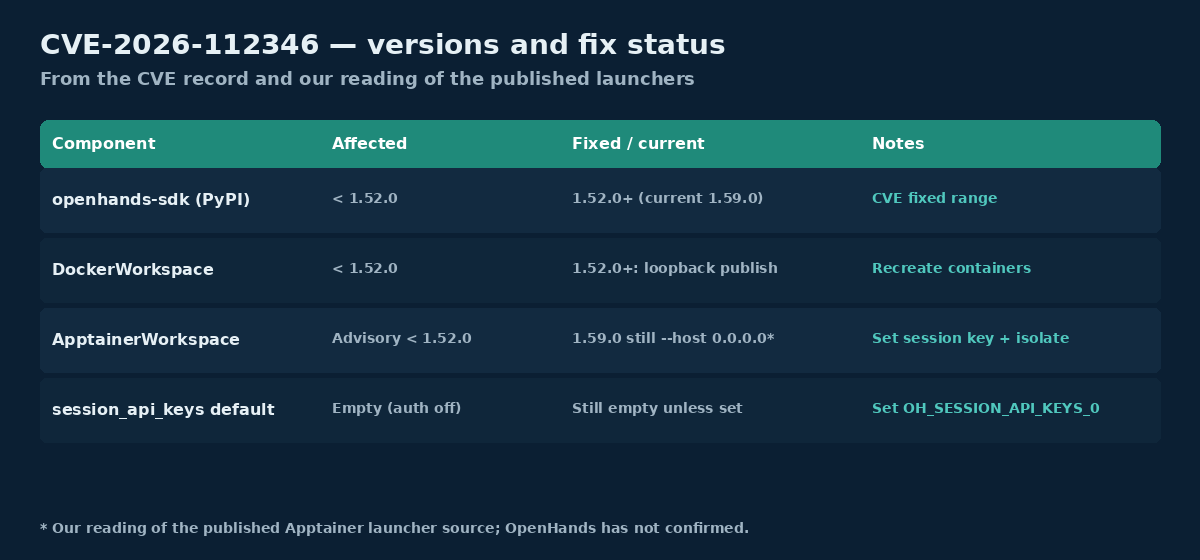
The record lists 1.52.0 (opens in a new tab) as the fix. It reached PyPI on 5 October, three weeks before the CVE, and the current release is 1.59.0. Four things are worth knowing before you call it done. We read them in OpenHands’ pull requests (opens in a new tab) and source code; OpenHands has not set them out in an advisory.
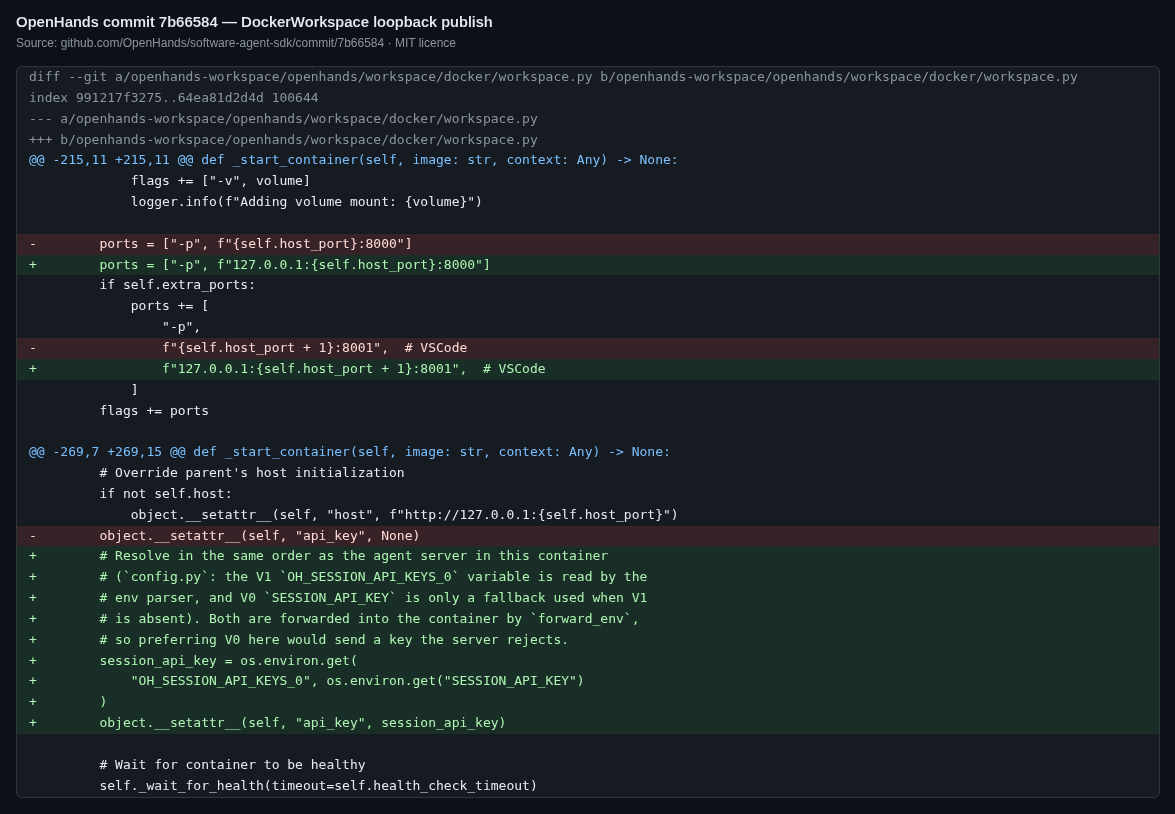
- Docker only. The fix (opens in a new tab) makes DockerWorkspace publish the agent server port (and the VS Code port next to it) on
127.0.0.1only. Inside the container the server still listens on every interface. - Authentication is still off by default. The server still accepts requests without a key unless
OH_SESSION_API_KEYS_0(orSESSION_API_KEY) is set. We confirmed this against the official 1.52.0 agent-server build. - In fairness. Since July the agent server itself listens only on
127.0.0.1by default when no session key is set, and warns when told to listen on all interfaces without one (pull request 4180 (opens in a new tab)). Both launchers pass a session key through if you set one. The launchers override the safe default by asking for0.0.0.0. - Apptainer looks unchanged. In our reading of the published code, the Apptainer launcher is identical in 1.51.0, 1.52.0 and 1.59.0 and still starts the server with
--host 0.0.0.0on a host port, and Apptainer containers normally share the host’s network. OpenHands has not confirmed this, and the CVE record lists 1.52.0 as the fix for both launchers. Until it says otherwise, we would not rely on upgrading alone on Apptainer hosts.
How to find it in your estate
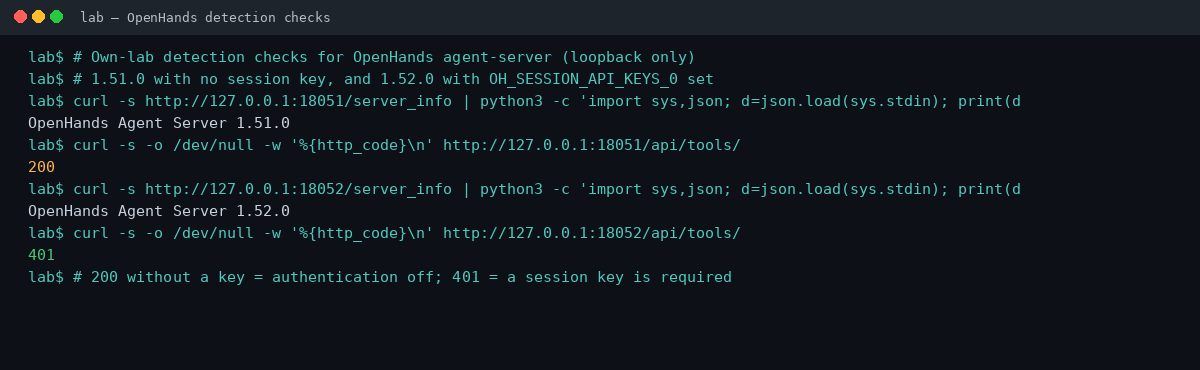
Only scan networks you own or are authorised to test. We ran the version and authentication checks below against the official 1.51.0 and 1.52.0 agent-server builds on a loopback address. We have not run the Docker and Apptainer commands in this test.
- Find the packages. Run
pip show openhands-sdk openhands-workspace openhands-agent-serverin each environment. Also search lockfiles and requirements files foropenhands-. Anything below 1.52.0 is affected. - Look at Docker port mappings. Run
docker ps --format '{{.Names}} {{.Image}} {{.Ports}}'and look for agent-server images (the default isghcr.io/openhands/agent-server). A mapping like0.0.0.0:36957->8000/tcpor[::]:36957->8000/tcpis reachable from other machines.127.0.0.1:36957->8000/tcpis the fixed default. Existing containers keep their old mappings until they are recreated. - Look at listening ports. On Linux,
ss -ltnpshows what is listening on0.0.0.0or[::]. When no port is set, the SDK picks one at random between 30000 and 39999, and the VS Code port is the next one up. Apptainer sandboxes show up here as the agent server process itself rather than a Docker proxy. - Ask the server. From another machine on your network,
curl -s http://HOST:PORT/server_infoanswers without a key and returns JSON containing"title":"OpenHands Agent Server"and the version. Then runcurl -s -o /dev/null -w '%{http_code}\n' http://HOST:PORT/api/tools/. A200means the server is not asking for a key. A401means a key is set. Both requests are read-only.
What to do
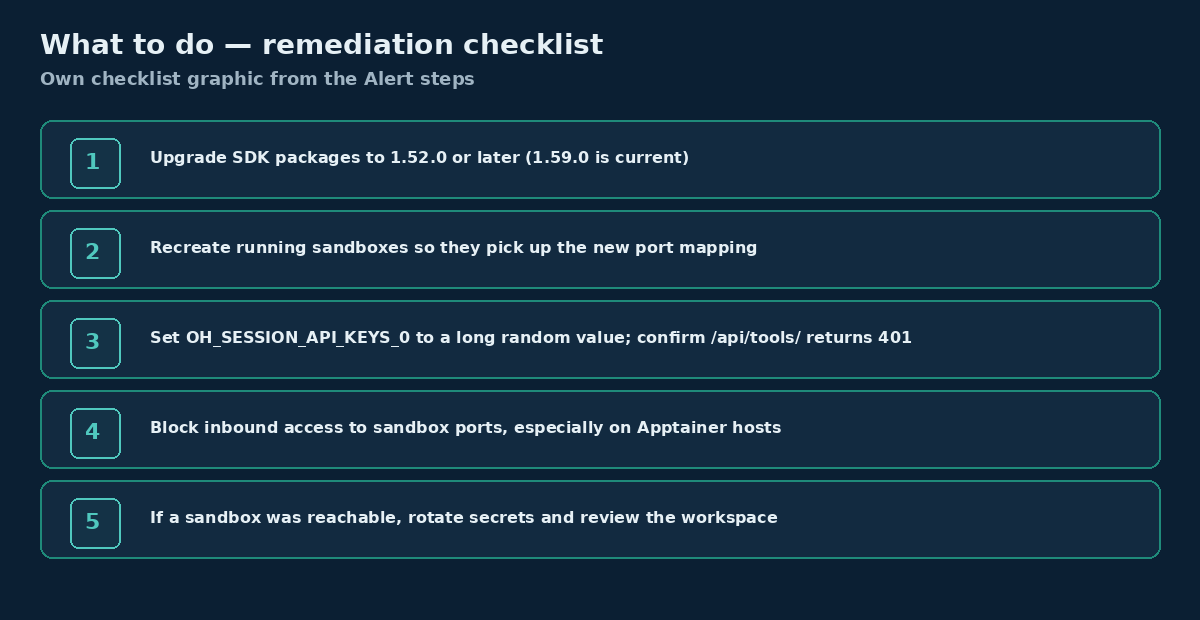
- Upgrade and recreate. Move the SDK packages to 1.52.0 or later (1.59.0 is current), then stop and recreate running sandboxes so they pick up the new port mapping.
- Set a session key. Set
OH_SESSION_API_KEYS_0to a long random value in the environment that launches the workspace, and check that/api/tools/now returns401without it. This is the step that actually turns authentication on, on every version and with both launchers. - Close the network path. Block inbound connections to the sandbox ports from other machines with a host firewall or security group, especially on Apptainer hosts. If you need remote sandboxes on purpose, put them behind a VPN or an authenticating proxy, never on the open internet.
- If a sandbox was reachable, assume it was used. Rotate the secrets it held: model provider API keys, Git and cloud tokens, and anything in the secrets store or in the mounted workspace. Review the workspace for changes you did not make before merging anything from it. This is our advice, not vendor guidance.
This is the same lesson as our round-up of four AI agent advisories: an agent’s sandbox is only as safe as whoever can reach its controls. We have not written a Hunt Lab rule for this one, because the problem is exposure, and the checks above find it.
Cyber-Threat.net asked OpenHands to comment on 27 October; it had not responded by our deadline of 09:30 GMT on 29 October. We will update this article if it does.
Sources
- CVE record for CVE-2026-112346 (opens in a new tab) (CNA: VulnCheck, published 26 October 2026), checked 29 October 2026
- VulnCheck: OpenHands Software Agent SDK < 1.52.0 Unauthenticated Sandbox Agent Server RCE (opens in a new tab) (published 26 October 2026), checked 29 October 2026
- NVD: CVE-2026-112346 (opens in a new tab) (awaiting analysis), checked 29 October 2026
- OpenHands Software Agent SDK v1.52.0 release (opens in a new tab) (published 5 October 2026), checked 29 October 2026
- OpenHands Software Agent SDK v1.59.0 release (opens in a new tab) (published 28 October 2026; no Apptainer bind-address change in the release notes), checked 29 October 2026
- OpenHands pull request 4180: default bind host to loopback without a session API key (opens in a new tab) (merged 23 July 2026), checked 29 October 2026
- OpenHands pull request 5209 (opens in a new tab) and commit 7b66584 (opens in a new tab), checked 29 October 2026
- OpenHands Apptainer workspace launcher, v1.59.0 source (opens in a new tab), checked 29 October 2026
- PyPI: openhands-sdk (opens in a new tab) (release history; current 1.59.0), checked 29 October 2026
- CISA Known Exploited Vulnerabilities catalogue (opens in a new tab) (catalogue version 2026.10.28; not listed), checked 29 October 2026
- FIRST EPSS (opens in a new tab) (score date 28 October 2026; 0.01014 / 63rd percentile), checked 29 October 2026
Follow Cyber-Threat.net RSSFeedly (opens in a new tab)X (opens in a new tab)Bluesky (opens in a new tab)LinkedIn (opens in a new tab)