


In three days at the end of October 2026, Dutch and allied police seized a bulletproof host’s Limburg servers and more than 3,000 customer records, a New York court jailed a Hive and Nefilim affiliate for 70 months, and the US Treasury designated Russian and North Korean facilitators of the DPRK IT-worker scheme. Boards that still treat ransomware payments and offshore hiring as operational irritants, rather than sanctions events, are reading the week wrong.
Applies to: any organisation that may pay a cyber ransom, hire remote IT labour, or rent hosting through opaque resellers — especially those with US, UK or EU nexus. Not legal advice; verify against the current SDN and UK Sanctions lists before any payment.
What happened this week
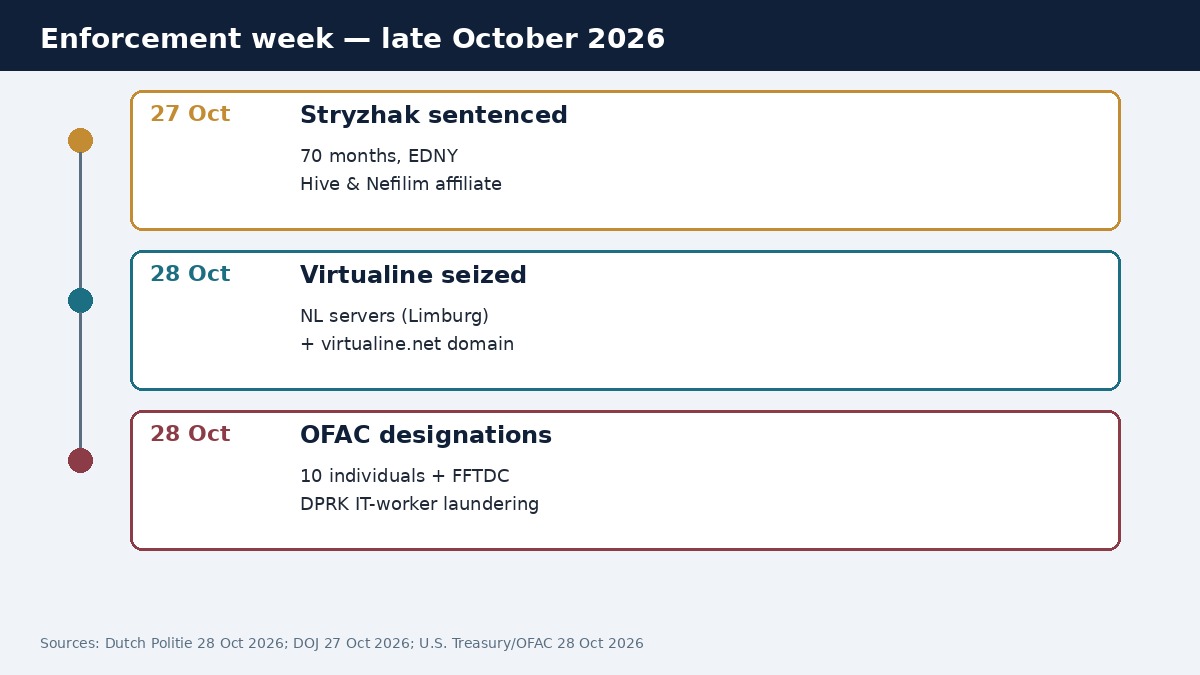
On 28 October 2026 the Dutch National Police’s Team Cybercrime (Midden-Nederland) announced (opens in a new tab) the seizure of dozens of physical servers in a Limburg data centre used by a bulletproof hosting provider. The firm had marketed itself on anonymity and on ignoring complaints and law-enforcement requests. Dutch investigators say the provider has, since 2022, been linked to ransomware, botnets, infostealers, phishing and the distribution of child sexual abuse material. Seizing the kit also took hundreds of virtual servers offline and put “data and details of more than 3,000 customers” who used the servers for criminal activity into police hands, with follow-up action against those users under way. The same operation saw concurrent action by the FBI and German police against suspects, cryptocurrency seizures, and the international disruption of the infrastructure.
The Record (opens in a new tab), citing US Justice Department materials, identifies the service as Virtualine (virtualine.net), which also traded under names including Secury, Massgod, Spamhouse, Lanedo and Omegatech. A court-authorised domain seizure has replaced the homepage with a splash page. Prosecutors allege the provider advertised hosting for “all illegal/black hat activities” on cybercrime forums, accepted bitcoin through a “BTC [NO-AML]” channel, and, after receiving complaints from German, Canadian and Australian authorities and from NCMEC, helped operators of a forum used to sell sexual images of minors build a further upload site rather than terminate them. The Record reports assistance from authorities in Germany, the Netherlands and Britain, and from OverRIPE and Lumen. The Dutch Politie release names concurrent FBI and German police action only; it does not name the UK. Treat British involvement as a secondary report, not as a Politie-sourced fact. At the time of the domain seizure the Justice Department had not publicly identified Virtualine’s operators or announced charges.
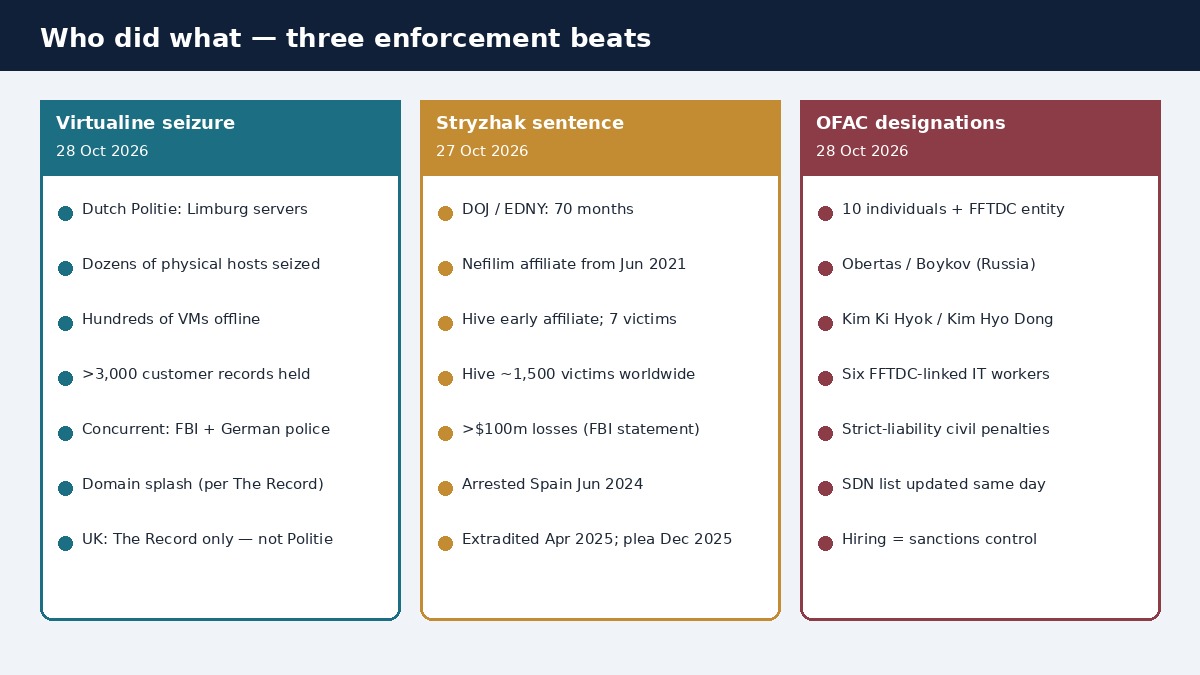
A day earlier, on 27 October 2026, the US Department of Justice announced (opens in a new tab) that Artem Stryzhak, 36, a Ukrainian national formerly of Barcelona, had been sentenced in the Eastern District of New York to 70 months’ imprisonment for conspiracy to commit computer fraud. According to the DOJ, he joined Nefilim as an affiliate from about June 2021, agreed with administrator Volodymyr Tymoshchuk to pay administrators 20 per cent of ransom proceeds, and separately joined Hive as one of its earliest affiliates. Hive conspirators attacked roughly 1,500 victims worldwide between June 2021 and January 2023; Stryzhak and co-conspirators deployed Hive against seven victims, including law firms, a dental office and a healthcare provider during the COVID-19 pandemic. The FBI’s Brett Leatherman said the groups caused more than $100 million in losses. Stryzhak was arrested in Spain in June 2024, extradited in April 2025 and pleaded guilty in December 2025. The Register (opens in a new tab) covered the sentence the same week; credit to Connor Jones’s reporting for the secondary summary.
On 28 October 2026 the US Treasury’s Office of Foreign Assets Control sanctioned (opens in a new tab) ten individuals and one entity — the Russia-based, DPRK-controlled First Financial and Technical Development Center (FFTDC) — for roles in North Korean IT-worker fraud against US businesses. Designated persons include Russian nationals Vitold Viktorovich Obertas and Ilya Aleksandrovich Boykov, DPRK nationals Kim Ki Hyok and Kim Hyo Dong, and six Russia-based DPRK IT workers linked to FFTDC. Treasury says Obertas conducted nearly $2 million in cryptocurrency conversions and at least $1.25 million in other currency transactions for DPRK officials since January 2025; Boykov has supported Alis with the equivalent of $3.5 million in cryptocurrency transactions since 2024; the six FFTDC-linked workers have generated over $750,000 since 2025. The SDN additions are on OFAC’s 28 October recent-actions page (opens in a new tab). The Record (opens in a new tab) summarised the package for a general audience.
Sanctions exposure is the board issue
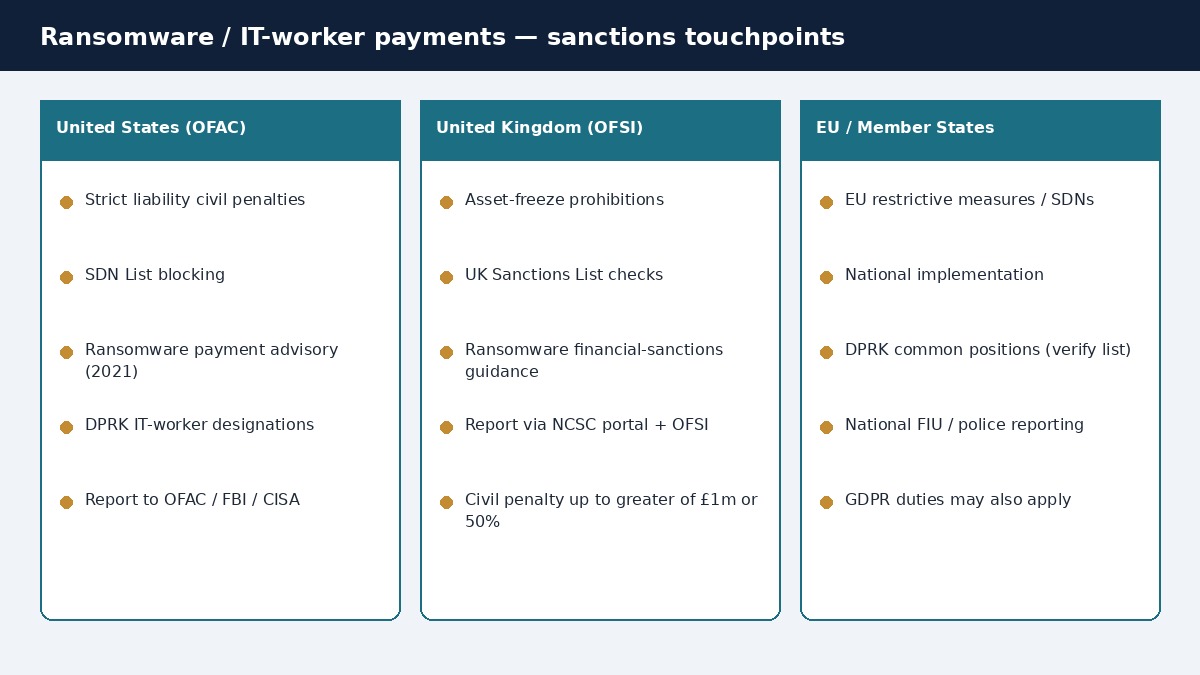
OFAC’s own September 2021 Updated Advisory on Potential Sanctions Risks for Facilitating Ransomware Payments (opens in a new tab) is still the clearest US primary text. It warns that companies facilitating ransomware payments — including financial institutions, cyber insurers and digital-forensics firms — may risk violating OFAC regulations where a payment reaches a sanctioned person or a comprehensively sanctioned jurisdiction. The US government “strongly discourages” ransom payments. Critically for boards, OFAC may impose civil penalties for sanctions violations on a strict liability basis: the Treasury’s 28 October release restates that point in the sanctions-implications section. Self-initiated, complete reporting to law enforcement and to agencies such as CISA or Treasury’s OCCIP, and ongoing cooperation, are mitigating factors under OFAC’s Enforcement Guidelines.
The UK picture is parallel, not identical. OFSI’s Financial sanctions guidance for ransomware (opens in a new tab) (updated 28 January 2026) states that the UK government does not condone ransomware payments; that making funds or cryptoassets available to a designated person is prohibited; and that breaches can attract a custodial sentence and/or a monetary penalty (statutory maximum the greater of £1 million or 50 per cent of the breach value). Prompt reporting through the NCSC “where to report a cyber incident” portal, and prompt voluntary disclosure to OFSI where a payment to a designated person is suspected, are mitigating factors. OFSI does not mandate a particular screening stack; the onus sits on the organisation.
Two practical consequences for this week’s facts. First, a ransom paid into infrastructure later tied to a designated ransomware actor, or routed through a laundering network that OFAC has now named, is a sanctions problem as well as a cyber one. Second, the DPRK IT-worker designations mean that payroll, contractor and cryptocurrency rails used to pay “remote developers” who turn out to be DPRK nationals — or their Russian facilitators — can themselves be a sanctions event. Treasury’s release is explicit that these networks use stolen identities, fabricated personas and AI tools to secure employment, then exfiltrate data and extort employers. Hiring due diligence is no longer only an HR control; it is a sanctions control.
EU restrictive measures against DPRK-related persons and entities also apply for EU operators; the precise list entry must be checked on the EU consolidated financial sanctions list before any payment. We have not checked whether each of this week’s OFAC designations has an EU counterpart, so treat the EU list as a live look-up, not a remembered one.
Hosting and supplier vetting
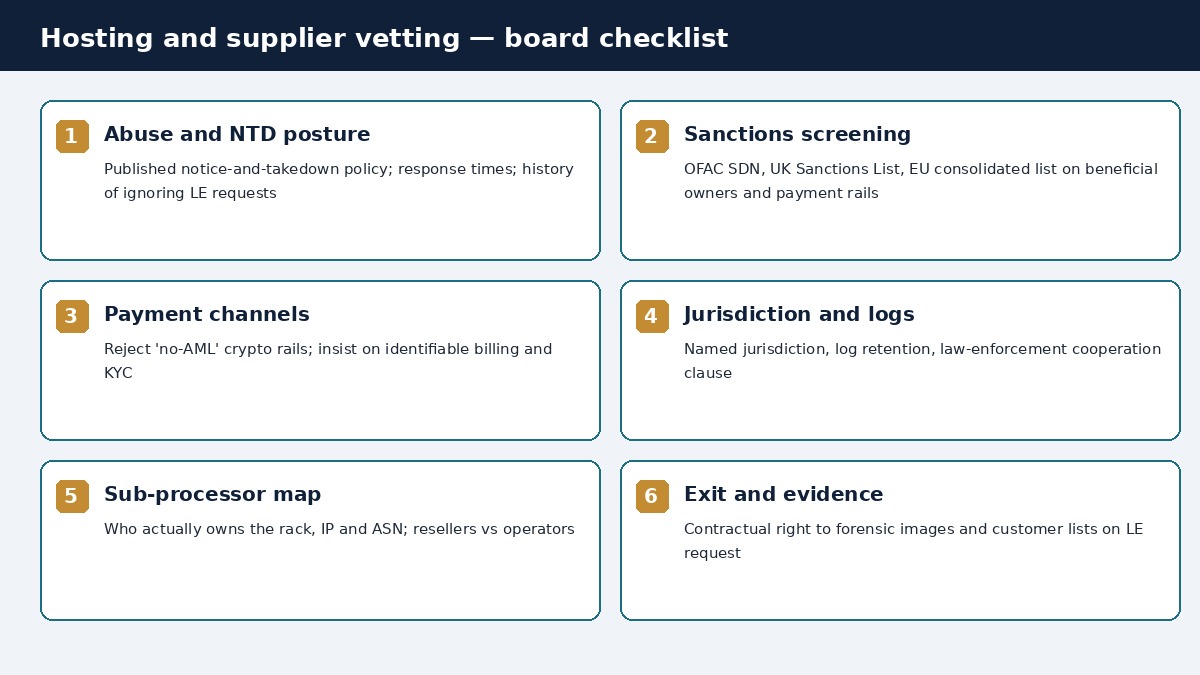
Bulletproof hosting is not a niche curiosity. It is the rental market for people who need abuse complaints ignored. The Dutch primary statement is careful to distinguish lawful Dutch hosts, “bad hosting” that facilitates crime unconsciously, and bulletproof hosts that do so deliberately. The ministry-level attention cited in the Politie release (kamerbrief of 6 July 2026 on bad hosting) and the renewed Dutch industry codes on abuse handling and notice-and-takedown are the domestic policy backdrop. For a board outside the Netherlands the lesson is simpler: if your crown-jewel workloads, phishing-resistant mail, or backup targets sit behind a reseller whose upstream advertises “NO-AML” crypto rails or boasts about ignored abuse, you have inherited their threat model.
Vet for published abuse and notice-and-takedown posture; for SDN, UK Sanctions List and EU consolidated-list screening of beneficial owners and payment processors; for identifiable billing rather than anonymous crypto; for a named jurisdiction, log retention and a cooperation clause; for a real map of who owns the rack, IP and ASN; and for a contractual right to forensic images when law enforcement comes calling. Resellers are not a shield. Virtualine’s alleged brand aliases are a reminder that the trading name on the invoice may be the least useful identifier you have.
Do takedowns actually dent ransomware?
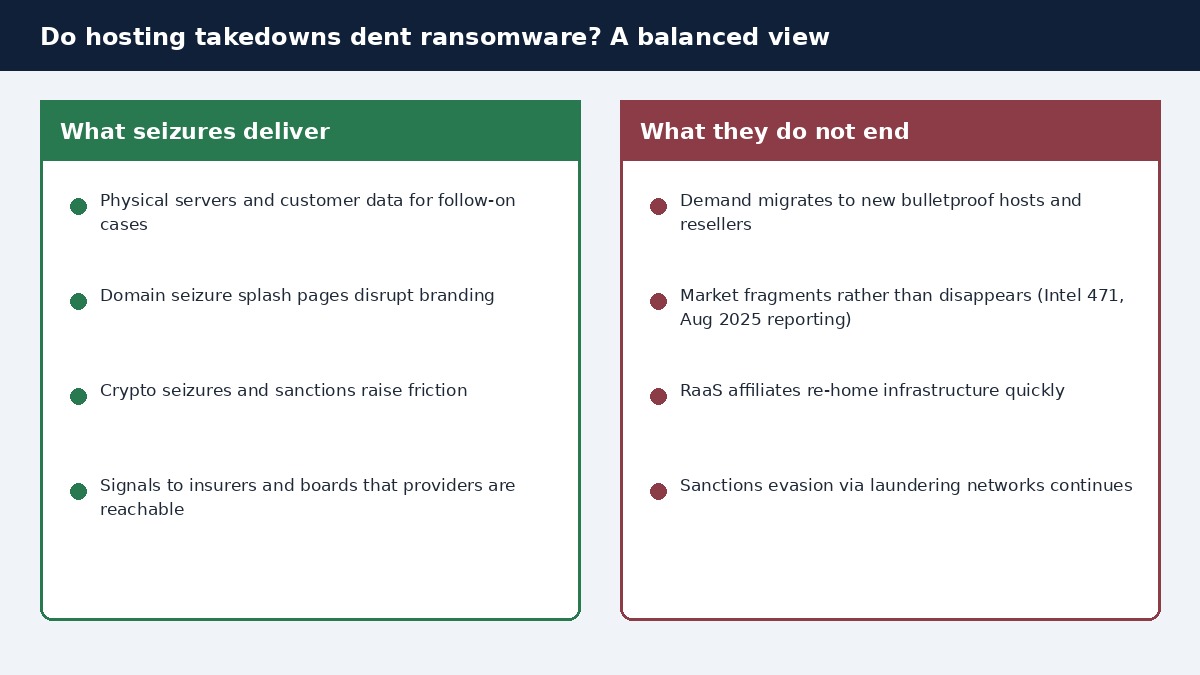
Honest answer: they raise friction and feed prosecutions; they do not abolish the market. The Virtualine seizure hands investigators customer data, wallet trails and a domain splash page — useful for follow-on cases, as the Politie release says is already under way. The Stryzhak sentence shows that affiliates who once treated Europe as a safe operating base can still face US prison time after extradition. OFAC designations freeze US-nexus property and warn the rest of the financial system off named facilitators.
The counter-argument is also evidenced. The Record notes prior actions against Zservers (2025), Aeza Group (2025), Media Land and Stark Industries. Intel 471 (opens in a new tab) (research covering disruptions from July 2025 through July 2026) assesses that those disruptions accelerated a shift toward a more fragmented market in which junior providers, former resellers and newly branded services absorb displaced demand rather than eliminating it. That matches what incident responders see operationally: RaaS affiliates re-home C2 and leak sites in days. Boards should therefore treat hosting takedowns as a source of intelligence and a reason to harden payment and supplier controls — not as proof that the ransomware problem has been solved upstream.
Board actions this quarter
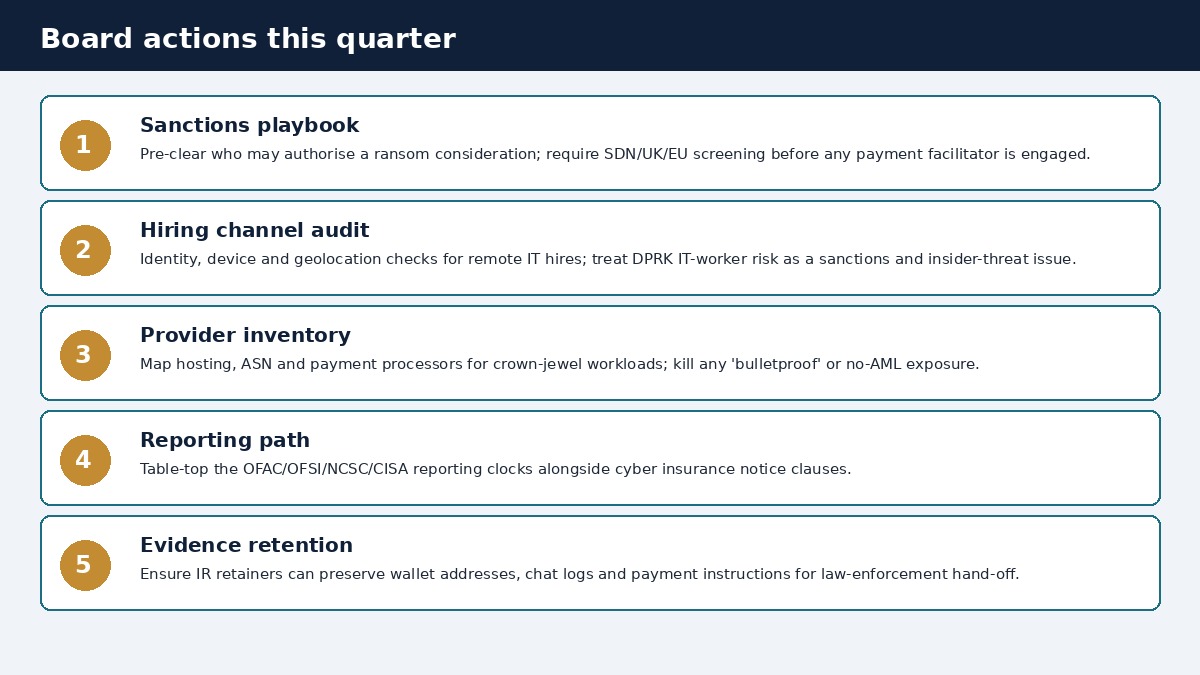
- Write the sanctions playbook before the incident. Name who may even discuss a ransom payment; require OFAC SDN, UK Sanctions List and EU consolidated-list screening before any facilitator is engaged; and record that OFAC civil liability can be strict and that OFSI expects prompt disclosure where a designated person is in the chain.
- Audit remote IT hiring. Identity proofing, device attestation, geolocation consistency and video interviews are now sanctions and insider-threat controls, not optional HR polish. Treasury’s FFTDC and Alis narrative is the reason.
- Inventory hosting and payment processors for crown-jewel and backup paths. Kill any exposure to providers that advertise anonymity, ignored abuse or no-AML rails.
- Table-top the reporting clocks — OFAC/FBI/CISA in the US, NCSC portal and OFSI in the UK, and national cyber and FIU channels in the EU — alongside cyber-insurance notice clauses.
- Preserve payment evidence. Wallet addresses, chat logs and payment instructions are what turn a painful outage into a prosecutable case and a mitigant with OFAC or OFSI. Your IR retainer should be contracted to keep them.
Primary sources: Dutch Politie, 28 October 2026; US DOJ, 27 October 2026; US Treasury/OFAC, 28 October 2026 and SDN recent actions; OFAC ransomware advisory, 21 September 2021; OFSI ransomware financial-sanctions guidance, updated 28 January 2026. Secondary credit: The Record (Virtualine; DPRK sanctions); The Register (Stryzhak).
Follow Cyber-Threat.net RSSFeedly (opens in a new tab)X (opens in a new tab)Bluesky (opens in a new tab)LinkedIn (opens in a new tab)