



ALERT · Actively exploited. Last updated 29 October 2026. See the Alert Tracker
If you run Cisco Secure Firewall ASA or Threat Defense with Remote Access SSL VPN and secondary authentication on any tunnel group, treat CVE-2026-76418 (opens in a new tab) as urgent. Cisco says the flaw is being exploited; CISA has not yet listed it on KEV.
What it is
CVE-2026-76418 (opens in a new tab) (Cisco bug CSCwx26625, CWE-690) is an unauthenticated denial-of-service in the Remote Access SSL VPN secondary-authentication path. A crafted HTTPS request can reload the device. Cisco rates it CVSS 3.1 8.6 High (AV:N/AC:L/PR:N/UI:N/S:C/C:N/I:N/A:H). It is the second ASA/FTD VPN DoS zero-day since August, after CVE-2026-20349 (opens in a new tab) (already on CISA KEV).
Who is affected
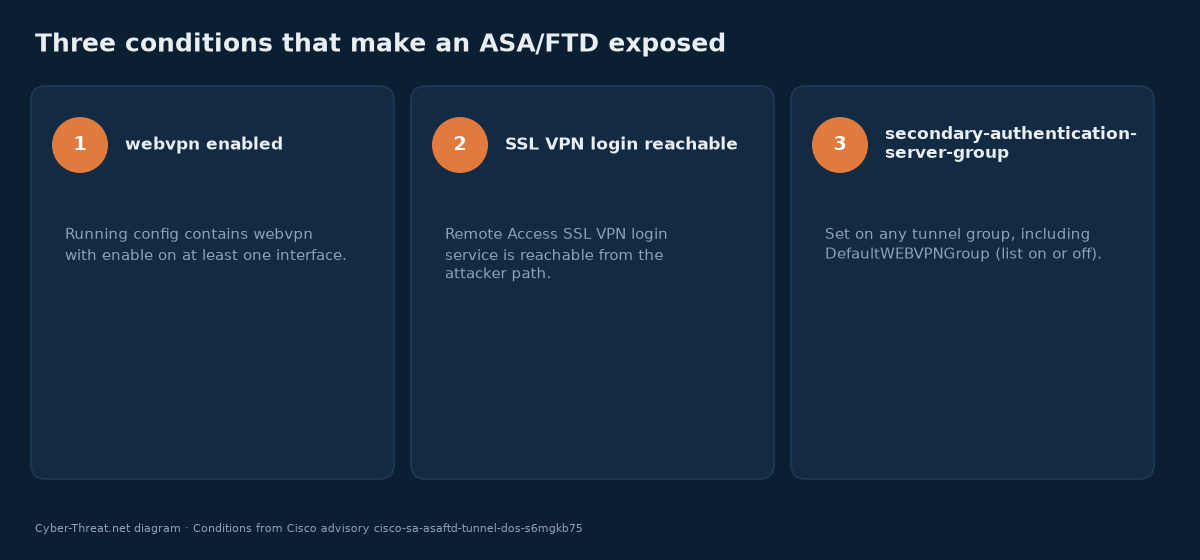
An ASA or FTD device is vulnerable when all three conditions are true:
webvpnis enabled on at least one interface.- The Remote Access SSL VPN login service is reachable from the attacker’s path.
secondary-authentication-server-groupis configured on any tunnel group, includingDefaultWEBVPNGroup— whether or nottunnel-group-listis enabled.
Not vulnerable per Cisco: Cloud-delivered Firewall (CDFW), Cloud-delivered Firewall Management Center (cdFMC), Cisco Secure Access, and Secure Firewall Management Center itself. On FTD managed by FMC, review Remote Access VPN under Devices > VPN.
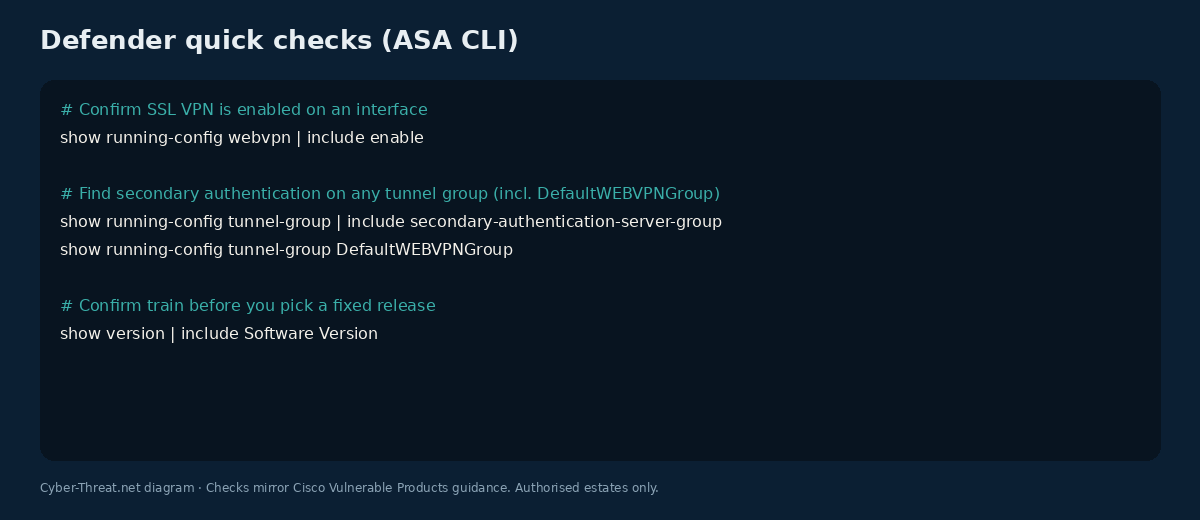
show running-config webvpn | include enable
show running-config tunnel-group | include secondary-authentication-server-group
show running-config tunnel-group DefaultWEBVPNGroup
show version | include Software Version
Exploitation status
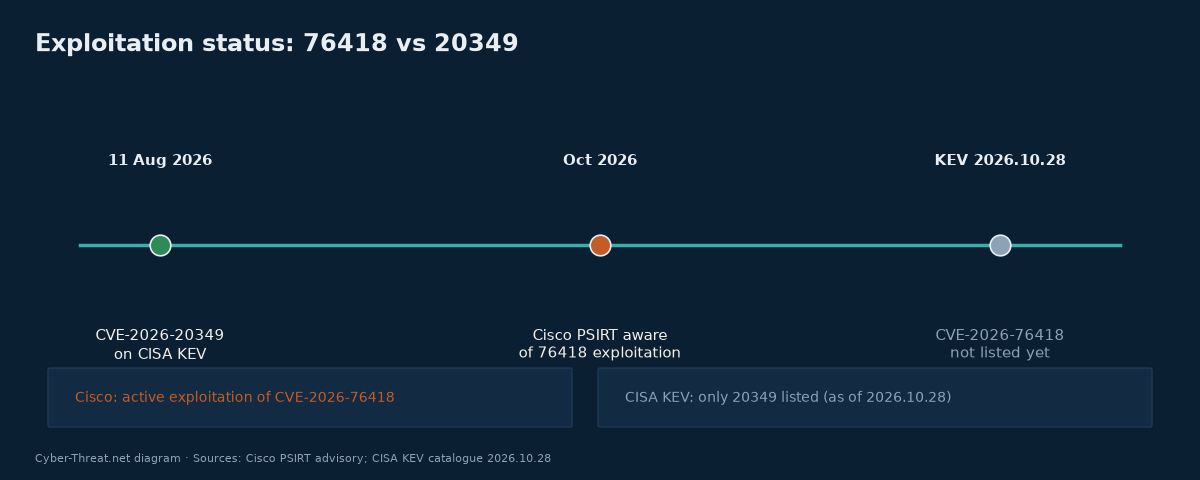
Cisco’s Product Security Incident Response Team states it is aware of active exploitation in October 2026. As of CISA KEV catalogue 2026.10.28 (checked 29 October 2026 Europe/London), CVE-2026-76418 is not listed. The earlier VPN DoS CVE-2026-20349 has been on KEV since 11 August 2026. FIRST has not yet published an EPSS score for CVE-2026-76418.
Fixed versions
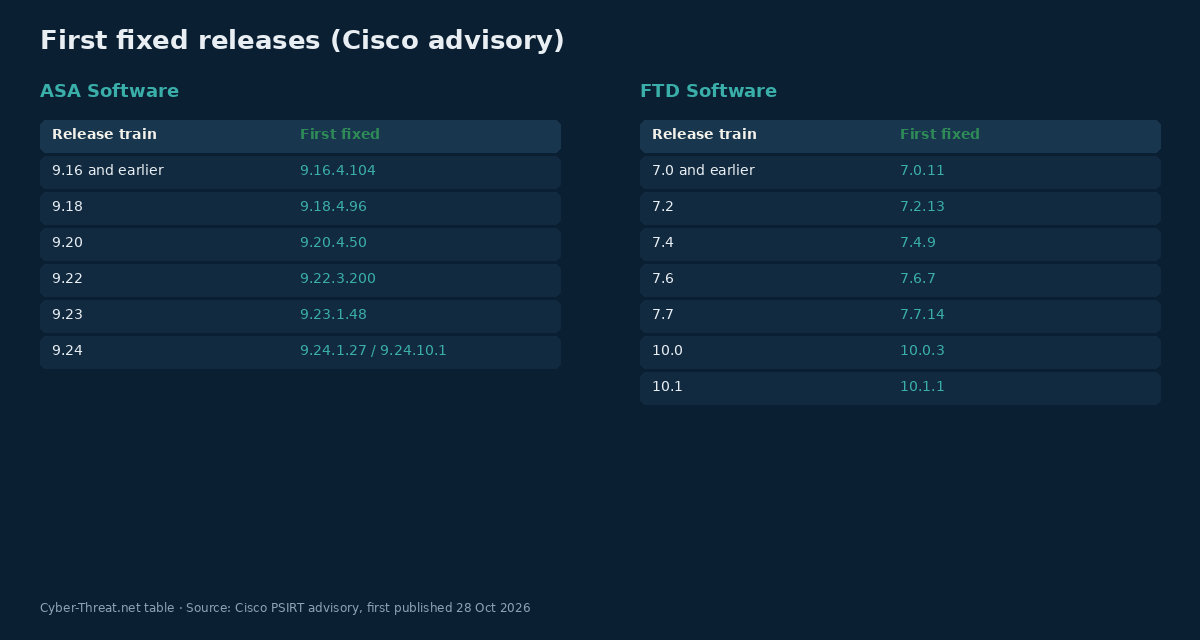
ASA Software — first fixed: 9.16.4.104 (covers 9.16 and earlier), 9.18.4.96, 9.20.4.50, 9.22.3.200, 9.23.1.48, 9.24.1.27 and 9.24.10.1.
FTD Software — first fixed: 7.0.11 (covers 7.0 and earlier), 7.2.13, 7.4.9, 7.6.7, 7.7.14, 10.0.3, 10.1.1.
Cisco lists no workarounds. Temporary mitigations that remove secondary authentication or disable tunnel-group-list reduce exposure but also weaken MFA posture — treat them as short-lived only.
How to hunt
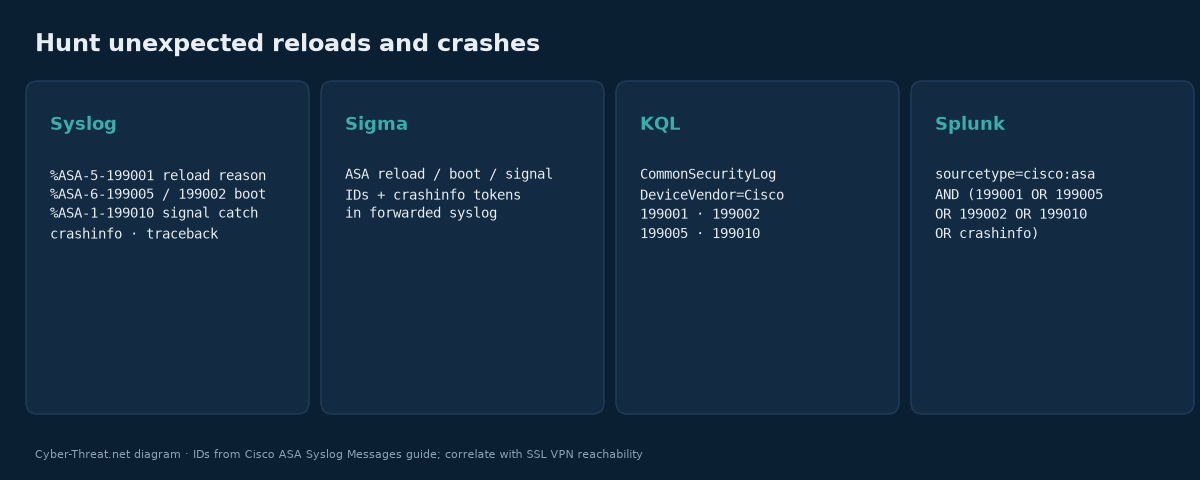
While you are still on a vulnerable train, hunt unexplained reloads and crash dumps that line up with SSL VPN reachability. Useful starting points (retarget to your field names):
# Verified ASA reload / boot / signal tokens (Cisco ASA Syslog Messages guide)
# https://www.cisco.com/c/en/us/td/docs/security/asa/syslog/asa-syslog/syslog-messages-101001-to-199021.html
%ASA-5-199001   # Reloaded at <time> by <user>. Reload reason: <reason>
%ASA-6-199005   # Startup begin
%ASA-6-199002   # Startup completed. Beginning operation.
%ASA-1-199010   # Signal <n> caught in process/fiber (serious-error recovery)
reload
crashinfo
traceback

# Splunk (CIM / cisco:asa)
index=* sourcetype=cisco:asa (reload OR crash OR crashinfo OR traceback OR "%ASA-5-199001" OR "%ASA-6-199002" OR "%ASA-6-199005" OR "%ASA-1-199010" OR "Reload reason" OR "Startup begin" OR "Startup completed")
| stats count min(_time) as first max(_time) as last by host, sourcetype

# Microsoft Sentinel / Defender XDR (KQL)
CommonSecurityLog
| where DeviceVendor == "Cisco" and DeviceProduct has_any ("ASA","FTD","Secure Firewall")
| where Message has_any ("reload","crash","crashinfo","traceback","199001","199002","199005","199010","Reload reason","Startup begin","Startup completed")
| summarize count(), min(TimeGenerated), max(TimeGenerated) by DeviceName, DeviceProduct
On the box itself, run show crashinfo / show crashinfo files and show version (uptime and last reload reason) and compare with change tickets — see Cisco’s crashinfo CLI and traceback RCA guidance. A Sigma starting point ships with this pack under hunt/. Planned upgrades also emit 199001/199005/199002, so correlate before you escalate. Failover-cable messages (%ASA-1-101001 / %ASA-1-101002) are not reload indicators.
What to do
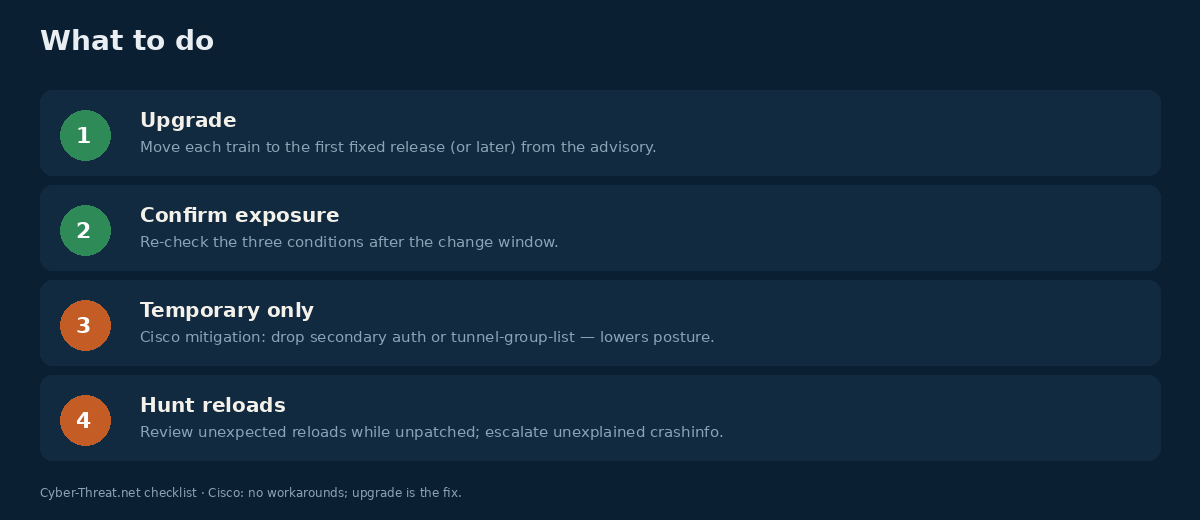
- Upgrade each ASA/FTD train to the first fixed release (or later) from the advisory.
- Re-run the three-condition check after the change window.
- Use Cisco’s temporary mitigations only if you cannot patch immediately, and restore MFA as soon as you can.
- Review unexpected reloads and crashinfo from the unpatched window; escalate anything without a matching change record.
Sources
- Cisco — ASA and FTD Software Remote Access SSL VPN DoS (cisco-sa-asaftd-tunnel-dos-s6mgkb75) (opens in a new tab) (28 October 2026)
- SecurityWeek — Second Cisco firewall VPN zero-day since August (opens in a new tab)
- CISA KEV (opens in a new tab) (catalogue 2026.10.28 — CVE-2026-76418 not listed; CVE-2026-20349 listed since 11 August 2026)
- NVD CVE-2026-76418 (opens in a new tab)
- Cisco Secure Firewall ASA Series Syslog Messages — 101001 to 199021 (opens in a new tab) (verified 199001 / 199002 / 199005 / 199010)
- Cisco ASA CLI — show crashinfo / show crashinfo files (opens in a new tab)
- Cisco — Collect data for RCA of software traceback/crash (opens in a new tab)
Follow Cyber-Threat.net RSSFeedly (opens in a new tab)X (opens in a new tab)Bluesky (opens in a new tab)LinkedIn (opens in a new tab)